


Corporate Governance Statement
Pursuant to Sections 289f and 315d of the German Commercial Code (HGB)
Responsible corporate governance sets the standard for the Executive Board and the Supervisory Board.
Good, responsible corporate governance geared toward sustainable, long-term value creation serves as the standard for the Executive Board and Supervisory Board of Continental AG to ensure they act in the interests of all stakeholder groups. The following corporate governance statement pursuant to Sections 289f and 315d of the German Commercial Code (Handelsgesetzbuch – HGB), to which reference is made in the management report, outlines corporate governance at Continental. The remuneration report for fiscal 2025 on the remuneration of the Executive Board and the Supervisory Board together with the auditor’s report and the valid remuneration system for the remuneration of the Executive Board are available on our website under Company/Corporate Governance/Executive Board. The valid remuneration system for remuneration of the Supervisory Board is described in the remuneration report for fiscal 2025 and is available on our website under Company/Corporate Governance/Supervisory Board.
Declaration pursuant to Section 161 of the German Stock Corporation Act (Aktiengesetz – AktG) and deviations from the German Corporate Governance Code (Deutscher Corporate Governance Kodex – DCGK)
In December 2025, the Executive Board and the Supervisory Board issued the following annual declaration pursuant to Section 161 AktG:
“The Executive Board and the Supervisory Board of Continental AG declare in accordance with Section 161 German Stock Corporations Act (AktG) that the recommendations of the ‘Government Commission on the German Corporate Governance Code’ in the version dated April 28, 2022 (published by the Federal Ministry of Justice in the official section of the electronic Federal Gazette (Bundesanzeiger) on June 27, 2022) have been complied with in the reporting year and will continue to be complied with, with the exception set out below.
Reference is made to the declaration of the Executive Board and the Supervisory Board of December 2024 as well as to previous declarations in accordance with Section 161 AktG and the deviations from the recommendations of the German Corporate Governance Code explained therein.
According to recommendation C.2 of the German Corporate Governance Code, the Supervisory Board shall set an age limit for members of the Supervisory Board. The Supervisory Board does not set an age limit because it does not consider such a general criterion to be appropriate for evaluating the qualifications of a Supervisory Board member.
Hanover, December 2025
Prof. Dr.-Ing. Wolfgang Reitzle
Chairman of the Supervisory Board
Nikolai Setzer
Chairman of the Executive Board”
The declaration of compliance is published on Continental’s website under Company/Corporate Governance/Principles and Declarations. Earlier declarations pursuant to Section 161 AktG can also be found there. Out-of-date corporate governance statements can also be found there for a period of at least five years from the date they were issued.
Key corporate governance practices
The following documents are key foundations of our sustainable and responsible corporate governance:
- Continental AG’s corporate guidelines. The vision, mission and values, desired behavior and self-image of the Continental Group; available on our website under Company/Corporate Governance/Vision & Mission.
- Sustainability ambition; available on our website under Sustainability.
- Compliance with the binding Code of Conduct for all Continental employees. For more information, see our website under Company/Corporate Governance/Vision & Mission/Our Code of Conduct.
Corporate bodies
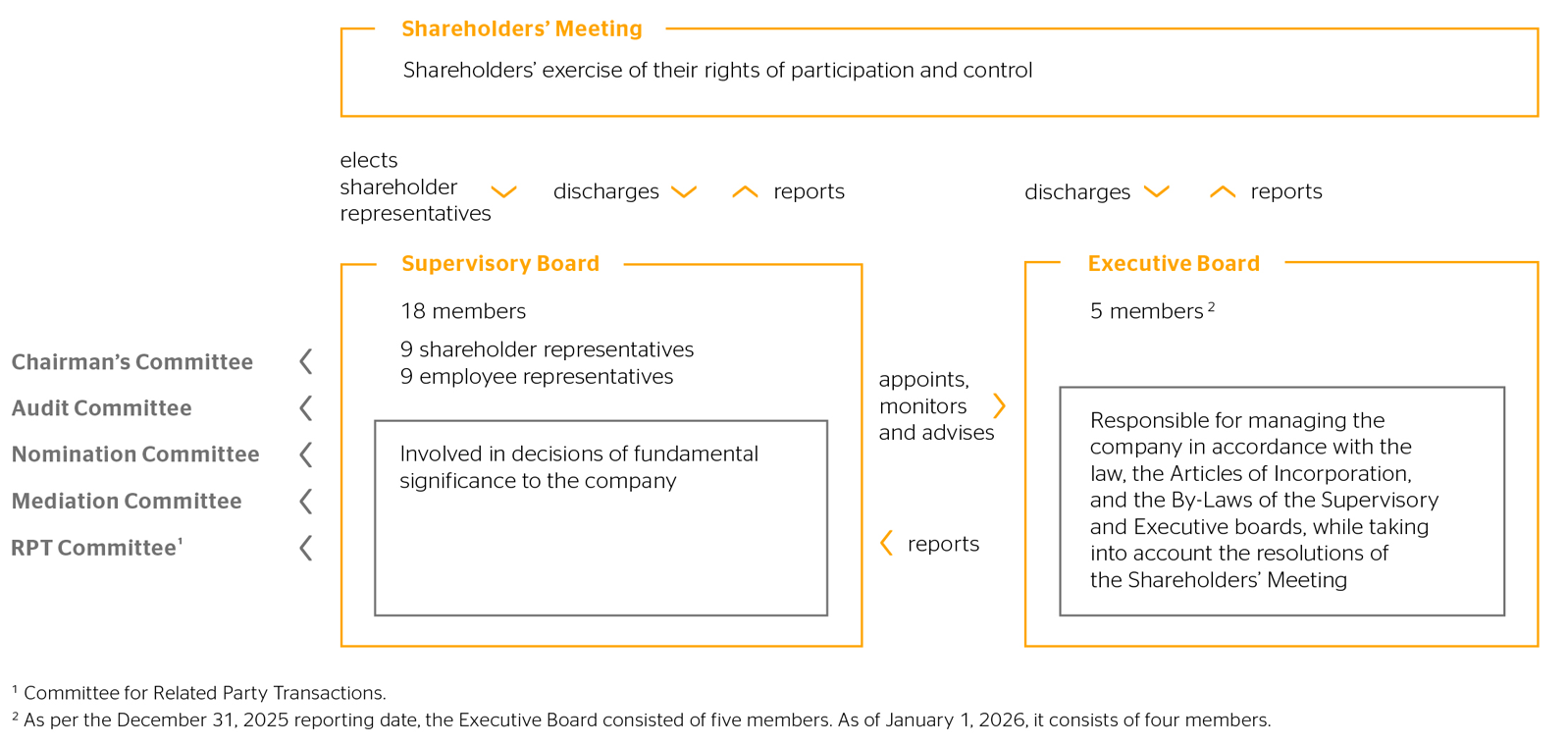
In line with the law and the Articles of Incorporation, the company’s corporate bodies are the Executive Board, the Supervisory Board and the Shareholders’ Meeting. As a German stock corporation, Continental AG has a dual management system characterized by a strict personnel division between the Executive Board as the management body and the Supervisory Board as the monitoring body. The cooperation between the Executive Board, Supervisory Board and Shareholders’ Meeting is depicted in the following overview.
The Executive Board and its practices
The Executive Board has sole responsibility for managing the company in the interests of the company, free from instructions from third parties in accordance with the law, the Articles of Incorporation and the Executive Board’s By-Laws, while taking into account the resolutions of the Shareholders’ Meeting. All members of the Executive Board share responsibility for the management of the company jointly. Regardless of this principle of joint responsibility, each Executive Board member is individually responsible for the areas entrusted to them. The chairman of the Executive Board is responsible for the company’s overall management and business policy. He ensures management coordination and uniformity on the Executive Board and represents the company to the public. The Executive Board jointly develops the company’s strategy, agrees it with the Supervisory Board and ensures its implementation.
In the past fiscal year, the Executive Board was expanded from six to seven members for a transitional period with the appointment of Roland Welzbacher, for the purpose of ensuring an orderly handover of the Finance and Controlling function. Philipp von Hirschheydt then stepped down from the Executive Board as part of the Aumovio spin-off. At the end of September, Olaf Schick resigned from the Executive Board as planned. The Executive Board therefore had five members as at December 31, 2025. With Nikolai Setzer stepping down from the Executive Board effective the end of December 31, the Executive Board has consisted of four members since January 1, 2026. Christian Kötz has also been chairman of the Executive Board since January 1, 2026. Information on areas of responsibility and résumés of the Executive Board members are available on our website under Company/Corporate Governance/Executive Board. The first time a person is appointed to the Executive Board, their term as a rule is three years only. As a rule, a member of the Executive Board is not appointed beyond the statutory retirement age.
Only under exceptional circumstances will a member of the Executive Board be reappointed earlier than one year prior to the end of their term of appointment with simultaneous annulment of their current appointment. More information on the members of the Executive Board can be found on page 333 and on our website under Company/Corporate Governance/Executive Board.
The Executive Board has By-Laws that regulate in particular the allocation of duties among the Executive Board members, key matters pertaining to the company and its subsidiaries that require a decision to be made by the Executive Board, the duties of the Executive Board chairman, and the process in which the Executive Board passes resolutions. The Executive Board By-Laws are available on our website under Company/Corporate Governance/Executive Board. The Supervisory Board By-Laws on the basis of the Articles of Incorporation require the consent of the Supervisory Board for significant actions taken by management.
Corporate bodies of the company
The Executive Board has established separate boards for the Tires and ContiTech group sectors. This supports the decentralization of responsibility that the global organization of the company seeks to achieve, and relieves the burden on the Executive Board. In addition to establishing these boards, the Executive Board has delegated to them decision-making powers for certain matters that affect only the relevant group sectors.
The boards for the two group sectors each comprise the Executive Board member responsible for the group sector in question as their chairman, the heads of the relevant business areas within the group sector, as well as further members from among the central functions of the relevant group sectors.
The Supervisory Board and its practices
The Supervisory Board appoints the members of the Executive Board and collaborates with the Executive Board to develop a long-term succession plan. The Supervisory Board discusses this topic on a regular basis without the Executive Board. In order to become acquainted with potential successors, the Supervisory Board, in consultation with the Executive Board, offers them the opportunity to introduce themselves to the Supervisory Board.
The Supervisory Board supervises and advises the Executive Board in managing the company. This includes, in particular, issues relating to the company’s strategy, planning, business development, risk situation, risk management, compliance and sustainability. The Supervisory Board is directly involved in decisions of material importance to the company. As specified by law, the Articles of Incorporation or the Supervisory Board By-Laws, certain corporate management matters require the approval of the Supervisory Board. The chairman of the Supervisory Board coordinates its work and represents it vis-à-vis third parties. Within reasonable limits, he is prepared to talk to investors about issues specific to the Supervisory Board. He maintains regular contact between meetings with the Executive Board, and in particular with its chairman, to discuss issues relating in particular to the company’s strategy, business development, risk situation, risk management and compliance.
Composition of the Supervisory Board
The Supervisory Board currently comprises 18 members. Half the members of the Supervisory Board are elected individually by the shareholders in the Shareholders’ Meeting (shareholder representatives), while the other half are elected by the employees of Continental AG and its German subsidiaries (employee representatives). Both the shareholder representatives and the employee representatives have an equal duty to act in the interests of the company. The Supervisory Board’s chairman is a shareholder representative. In accordance with the provisions of the Co-determination Act, he has the casting vote in the event of a tie.
The current Supervisory Board was constituted on April 26, 2024. The term of office of the employee representatives lasts until the end of the 2029 Annual Shareholders’ Meeting. The term of office of the shareholder representatives varies in accordance with the staggered board concept. Under this concept, the terms of office of the shareholder representatives do not run in parallel; instead, two groups of shareholder representatives are elected in staggered cycles for a term of office of four years each. Personnel changes related to the Aumovio spin-off are explained in the report of the Supervisory Board (starting on page 13). The chairman of the Supervisory Board is Prof. Dr.-Ing. Wolfgang Reitzle, who, in accordance with the German Corporate Governance Code, is independent of the company and its Executive Board. The Supervisory Board does not include any members who previously belonged to the Executive Board of Continental AG, who exercise an executive function or advisory role at a major competitor of Continental, or who have a personal relationship with such a competitor.
The company has set up an informational program that provides newly elected members of the Supervisory Board with a comprehensive overview of the company’s products and technologies as well as finances, controlling and corporate governance at Continental.
The Supervisory Board has drawn up its own By-Laws that supplement the law and the Articles of Incorporation with more detailed provisions, including provisions on Supervisory Board meetings, the duty of confidentiality, the handling of conflicts of interest and the Executive Board’s reporting obligations, and a list of transactions and measures that require the approval of the Supervisory Board. The Supervisory Board By-Laws are available on our website under Company/Corporate Governance/Supervisory Board. The Supervisory Board also consults on a regular basis in the absence of the Executive Board. Before each regular meeting of the Supervisory Board, the representatives of the shareholders and of the employees each meet separately with members of the Executive Board to discuss the upcoming meeting.
The Supervisory Board regularly reviews how effectively it and its committees have fulfilled their responsibilities. It recently carried out such a review in 2021 with the help of an external consultant. This confirmed the Supervisory Board’s efficient and professional approach to its work in the past years. The Supervisory Board has adopted the recommendations from the 2021 self-assessment.
Profile of skills and expertise for the Supervisory Board
In accordance with recommendation C.1 of the German Corporate Governance Code, the Supervisory Board has prepared a profile of skills and expertise and specified targets for its composition. The Supervisory Board adopted the current profile of skills and expertise in December 2025.
The Supervisory Board as a whole should possess the skills and expertise noted below. It is not expected that all Supervisory Board members possess all of the skills and expertise noted below. Instead, each area of expertise must be covered by at least one Supervisory Board member. The profile of skills and expertise assumes that all Supervisory Board members possess the knowledge and skills required for the proper performance of their duties and the characteristics necessary for successful Supervisory Board work in an internationally active, capital market-oriented company. In particular, these include integrity, commitment, capacity for discussion and teamwork, sufficient availability and discretion.
The Supervisory Board members should collectively cover all skills, expertise and experience deemed to be significant in view of Continental’s business activities. These include in particular:
- Skills, expertise and experience related to corporate governance, particularly in the areas of:
- Executive board experience
- Supervisory board experience
- Strategy and management
- Mergers and acquisitions (M&A)
- Organizational development and strategic personnel planning
- Digitalization and artificial intelligence
- Law and compliance
- Sector- and company-specific experience, particularly in the areas of:
- Industry (i.e. the tire, chemical and automotive industries)
- Research and development
- Manufacturing and logistics
- Marketing and sales (multi-stage, business-to-business-to-consumer (B2B2C) and digital business models)
- International experience, particularly in the regions of:
- Europe
- North and South America
- China
- Asia-Pacific
- Skills, expertise and experience in sustainability, particularly in the areas of:
- Environment
- Social responsibility
- Skills, expertise and experience in risk management and reporting, particularly in the areas of:
- Financial and sustainability reporting, control systems
- Auditing of financial statements
The Supervisory Board has also specified the following targets for its composition:
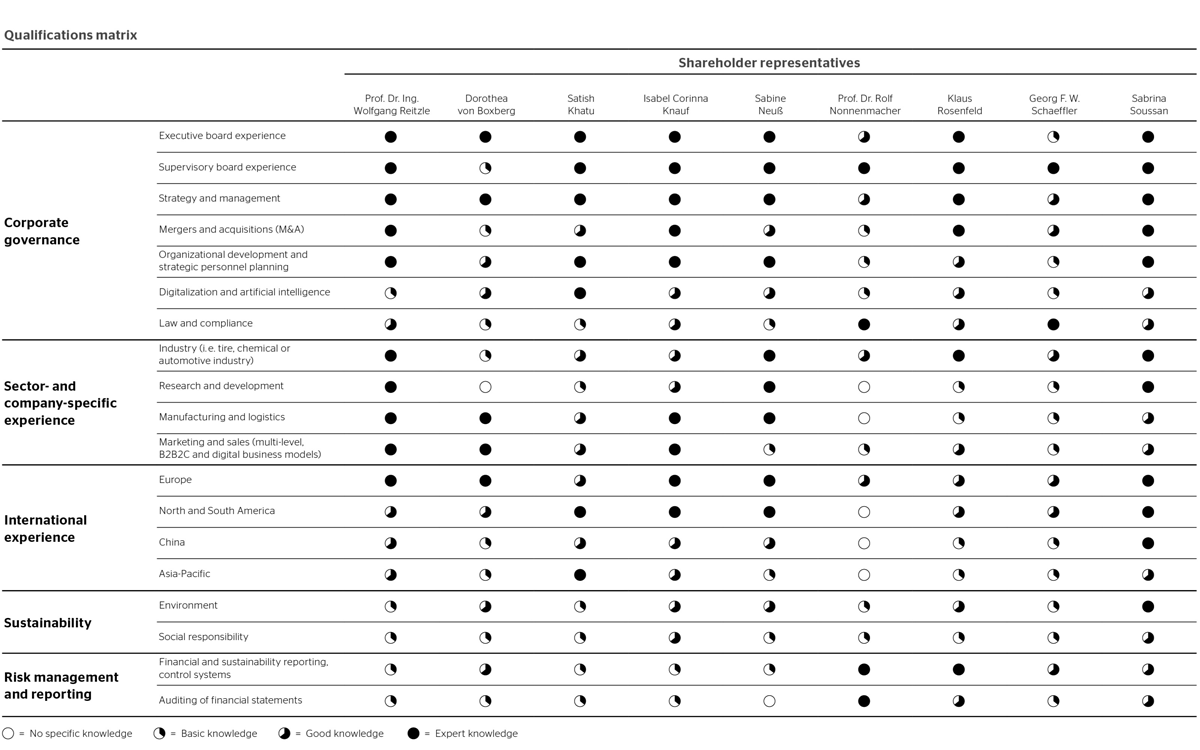
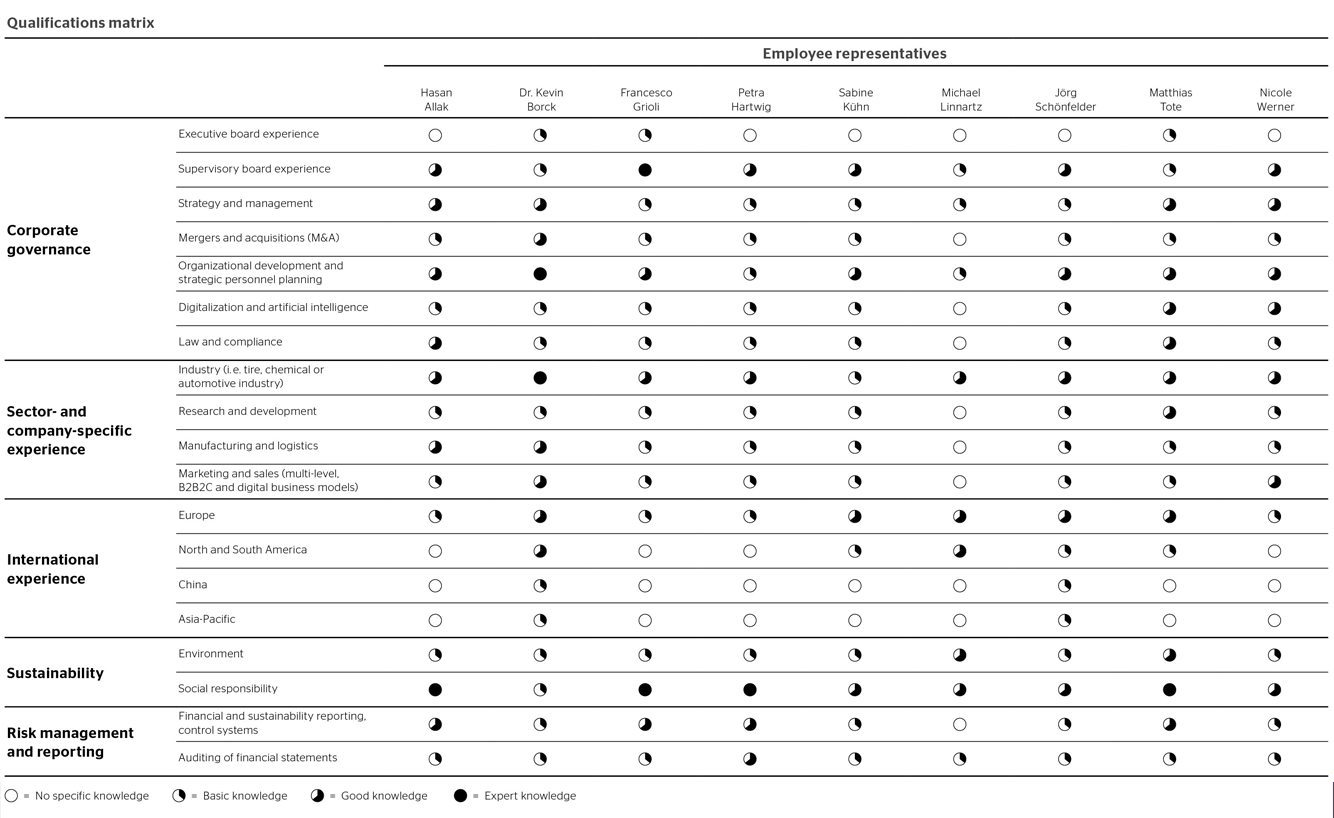
- Professional skills and expertise: The personal and professional qualifications defined in the profile of skills and expertise should be covered as broadly as possible by the candidates proposed for election. The progress achieved to date in implementing the profile of skills and expertise can be viewed in the qualifications matrix.
- Independence: The Supervisory Board should have an appropriate number of members on the shareholder side whom it deems to be independent in accordance with the German Corporate Governance Code. Taking into account the ownership structure, a Supervisory Board member is therefore considered independent if they are independent of the company and its Executive Board, and also independent of a controlling shareholder. The Supervisory Board has specified the following targets for this purpose:
- More than half of the shareholder representatives should be independent of Continental AG and its Executive Board.
The independence of shareholder representatives was assessed in accordance with the German Corporate Governance Code by shareholder representatives on the Supervisory Board. As part of the assessment of independence from the Executive Board and the company, it was taken into account that four shareholder representatives had been members of the Supervisory Board for more than 12 years in 2025. In the assessment of the independence of these four shareholder representatives, given the former and ongoing administration of the members in question, the shareholder representatives overall see no grounds to change the existing assessment of independence. The shareholder representatives currently on the Supervisory Board are therefore all, without exception, independent of Continental AG and its Executive Board. - At least five shareholder representatives should be independent of the controlling shareholder, the IHO Group, headquartered in Herzogenaurach, Germany.
It was taken into consideration in the assessment of independence from any controlling shareholder that two Supervisory Board members are linked to the controlling shareholder, the IHO Group, Herzogenaurach, Germany. As determined in the assessment by the shareholder representatives on the Supervisory Board, the Supervisory Board still has an appropriate number of members on the shareholder side who are independent in accordance with the German Corporate Governance Code. These include: - Prof. Dr.-Ing. Wolfgang Reitzle
- Dorothea von Boxberg
- Satish Khatu
- Isabel Corinna Knauf
- Sabine Neuß
- Prof. Dr. Rolf Nonnenmacher
- Sabrina Soussan
- Term of office: In its nominations for election to the Supervisory Board, the Supervisory Board as a rule does not nominate candidates who at the time of election have already been a member of the Supervisory Board for 12 years.
Qualifications matrix - Shareholder representatives
Qualifications matrix - Employee representatives
| Targets for composition | Independence from the company and Executive Board in accordance with the DCGK | ||||
|---|---|---|---|---|
| Independence from company and Executive Board pursuant to recommendation C.7 DCGK | Independence from controlling shareholder pursuant to recommendation C.9 DCGK | Term of office | ||
| Targets | More than 50% of shareholder representatives | At least five shareholder representatives | As a rule, no election proposal after 12 years in office | Year of appointment |
| Prof. Dr.-Ing. Wolfgang Reitzle | 2009 | |||
| Dorothea von Boxberg | 2022 | |||
| Satish Khatu | 2019 | |||
| Isabel Corinna Knauf | 2019 | |||
| Sabine Neuß | 2014 | |||
| Prof. Dr. Rolf Nonnenmacher | 2014 | |||
| Klaus Rosenfeld | 2009 | |||
| Georg F. W. Schaeffler | 2009 | |||
| Sabrina Soussan | 2025 | |||
| = Yes = no | ||||
Committees of the Supervisory Board
The Supervisory Board currently has five committees with decision-making powers: the Chairman’s Committee, the Audit Committee, the Nomination Committee, the committee formed in accordance with Section 27 (3) of the German Co-determination Act (Mitbestimmungsgesetz – MitbestG (the Mediation Committee) and the committee for the approval of company transactions with related persons (Committee for Related Party Transactions, RPT Committee) (Section 107 (3) Sentence 4; Section 111b (1) AktG).
Key responsibilities of the Chairman’s Committee are preparing the appointment of Executive Board members and concluding, terminating and amending their employment contracts and other agreements with them. However, the plenum of the Supervisory Board alone is responsible for stipulating the total remuneration of the Executive Board members. Another key responsibility of the Chairman’s Committee is deciding on the approval of certain transactions and measures by the company as specified in the Supervisory Board By-Laws. The Supervisory Board has conferred some of these participation rights on the Chairman’s Committee, each member of which may however, in individual cases, demand that a matter again be submitted to the plenary session for decision. The members of the Chairman’s Committee are Prof. Dr.-Ing. Wolfgang Reitzle (chairman); his vice chairman, Hasan Allak; Francesco Grioli; and Georg F. W. Schaeffler.
The Audit Committee primarily deals with the audit of the accounts, the monitoring of the accounting process and the effectiveness of the internal control system, the risk management system and the internal audit system, the audit of the financial statements (including sustainability reporting and examination thereof) and compliance. In particular, the committee deals with the preliminary examination of Continental AG’s annual financial statements and the consolidated financial statements, and makes its recommendation to the plenary session of the Supervisory Board, which then passes resolutions pursuant to Section 171 AktG. Furthermore, the committee discusses the company’s draft interim financial reports. It is also responsible for ensuring the necessary independence of the auditor and deals with additional services performed by the auditor. The committee engages the auditor, determines the focus of the report as necessary, negotiates the fee and regularly reviews the quality of the audit. The chairman of the Audit Committee regularly consults with the auditor on the progress of the audit and reports on this to the committee. The committee also regularly consults with the auditor without the Executive Board. It also gives its recommendation for the Supervisory Board’s proposal to the Annual Shareholders’ Meeting for the election of the auditor. The Audit Committee is also responsible for the preliminary audit of non-financial reporting and sustainability reporting and for the engagement of an auditor for its review. The chairman of the Audit Committee is Prof. Dr. Rolf Nonnenmacher, who is independent in accordance with the German Corporate Governance Code. As an auditor with many years of professional experience in management positions, he has in-depth knowledge and experience in auditing. Another committee member, Klaus Rosenfeld, is also a financial expert, and as chief financial officer in a number of companies has in-depth knowledge and experience in accounting and internal control and risk management systems. The other members are Francesco Grioli, Michael Linnartz, Georg F. W. Schaeffler and Matthias Tote. Neither a former Executive Board member nor the chairman of the Supervisory Board may act as chairman of the Audit Committee.
The Nomination Committee is responsible for nominating suitable candidates for the Supervisory Board to propose to the Annual Shareholders’ Meeting for election. In addition, the committee must propose targets for the Supervisory Board’s composition and profile of skills and expertise and review both regularly. The Nomination Committee consists entirely of shareholder representatives, specifically the two members of the Chairman’s Committee, Prof. Dr.-Ing. Wolfgang Reitzle (chairman) and Georg F. W. Schaeffler; the chairman of the Audit Committee, Prof. Dr. Rolf Nonnenmacher; and Isabel Corinna Knauf.
In accordance with Section 31 (3) Sentence 1 MitbestG, the Mediation Committee becomes active only if the first round of voting on a proposal to appoint a member of the Executive Board or to remove a member by consent does not achieve the legally required two-thirds majority. This committee must then attempt mediation before a new vote is taken. The members of the Chairman’s Committee are also the members of the Mediation Committee.
The Committee for Related Party Transactions (RPT Committee) deals with transactions between Continental AG and a related person, where these transactions require the prior consent of Continental AG’s Supervisory Board in accordance with Sections 111a and 111b AktG. Transactions in this case require the prior consent of the Supervisory Board. In addition to the chairman of the Supervisory Board, Prof. Dr.-Ing. Wolfgang Reitzle, and the chairman of the Audit Committee, Prof. Dr. Rolf Nonnenmacher, the Committee for Related Party Transactions includes two further members elected by the Supervisory Board from among the employee representatives where necessary.
The Sustainability Working Group established by the Supervisory Board deals with sustainability issues relevant to Continental. The working group includes two shareholder representatives, Dorothea von Boxberg and Sabine Neuß, and two employee representatives, Jörg Schönfelder and Nicole Werner.
More information on the members of the Supervisory Board and its committees can be found on pages 334 and 335. Current résumés, which are updated annually, are available on our website under Company/Corporate Governance/Supervisory Board. They also contain information on how long each member has held their position on the Supervisory Board.
Shareholders and the Shareholders’ Meeting
The company’s shareholders exercise their rights of participation and control at the Annual Shareholders’ Meeting. The Annual Shareholders’ Meeting, which must be held in the first eight months of every fiscal year, decides on all issues assigned to it by law, such as the appropriation of profits, the election of shareholder representatives to the Supervisory Board, the discharging of Supervisory Board and Executive Board members, the appointment of auditors and the approval of the remuneration system and remuneration report. Each Continental AG share entitles the holder to one vote. There are no shares conferring multiple or preferential voting rights and no limitations on voting rights.
All shareholders who register in a timely manner and prove their entitlement to participate in the Shareholders’ Meeting and to exercise their voting rights are entitled to participate in the Shareholders’ Meeting. To facilitate the exercise of their rights and to prepare them for the Shareholders’ Meeting, the shareholders are fully informed about the past fiscal year and the points on the upcoming agenda before the Shareholders’ Meeting by means of the annual report and the invitation to the meeting. All documents and information on the Annual Shareholders’ Meeting, including the annual report, are published on Continental’s website in German and English. Moreover, the Annual Shareholders’ Meeting can also be watched in full in an audio-visual stream on the company’s website. When holding the Annual Shareholders’ Meeting, the chairperson presiding over the meeting is guided by the fact that an ordinary annual shareholders’ meeting should be concluded after four to six hours. To make it easier for shareholders to exercise their rights, the company offers all shareholders who cannot or do not want to exercise their voting rights during the Annual Shareholders’ Meeting themselves the opportunity to vote at the Annual Shareholders’ Meeting via a proxy who is bound by instructions or through absentee voting. The required voting instructions can also be issued to the proxy via an internet service (InvestorPortal) before the end of the general debate on the day of the Shareholders’ Meeting. In addition, the service provider that assists the company with conducting the Shareholders’ Meeting is instructed not to forward the individual voting instructions to Continental until the day before the Shareholders’ Meeting.
Accounting and auditing of financial statements
The Continental Group’s accounting is prepared in accordance with IFRS® Accounting Standards (IFRS) as adopted by the European Union (EU). The annual financial statements of Continental AG are prepared in accordance with the accounting regulations of the German Commercial Code. The Annual Shareholders’ Meeting on April 25, 2025, elected PricewaterhouseCoopers GmbH Wirtschaftsprüfungsgesellschaft, Hanover branch (PwC) to audit the consolidated financial statements for fiscal 2025 as well as the interim financial reports of the company. Dr. Arne Jacobi is the responsible auditor at PwC.
Internal control system and risk management
Diligent corporate management and good corporate governance also require that the company deal with risks responsibly. Continental has a corporate-wide internal control and risk management system that is used to analyze and manage the company’s risk situation. We report on this in detail in the report on risks and opportunities starting on page 74, which forms part of the management report for the consolidated financial statements.
Transparent and prompt reporting
As part of our investor relations and corporate communications, we regularly report to shareholders, analysts, shareholders’ associations, the media and interested members of the public in equal measure on significant developments in the company and its situation. All shareholders have instant access to all the information that is also available to financial analysts and similar parties. The website of Continental AG provides the latest information, including the company’s financial reports, presentations held at analyst and investor conferences, press releases and ad-hoc disclosures. The dates of key periodic publications (annual report, quarterly statements and half-year report) and events as well as of the Annual Shareholders’ Meeting and the annual press conference are announced well in advance in a financial calendar on the website of Continental AG. For the scheduled dates for 2026, see the Investors/Events/Financial Calendar section.
Reporting pursuant to Section 289f (2) Nos. 4 to 6 HGB
Pursuant to Section 96 (2) AktG, the Supervisory Board of Continental AG as a listed stock corporation subject to the German Co-determination Act consists of at least 30% women and at least 30% men. This minimum quota must, as a general rule, be fulfilled by the Supervisory Board as a whole. Due to an objection by the employee representatives against the overall fulfillment in accordance with Section 96 (2) Sentence 3 AktG before the election of the Supervisory Board in spring 2024, the minimum quota for the Supervisory Board of Continental AG must be fulfilled separately by the shareholder representatives and the employee representatives. Women made up 44% of shareholder representatives and 33% of employee representatives as at December 31, 2025.
For Continental AG, as a listed stock corporation subject to the German Co-determination Act, the ratio requirement as set out in Section 76 (3a) AktG applies, according to which any Executive Board composed of more than three persons should have at least one woman and one man as members of the Executive Board. This requirement was met in the fiscal year under review.
In accordance with Section 76 (4) AktG, the Executive Board of Continental AG is required to set targets for the ratio of women in the first two management levels below the Executive Board and a deadline for achieving these targets. In December 2021, the Executive Board set new target quotas for women in the first two management levels below the Executive Board at Continental AG for the period up until December 31, 2026: 37% for the first management level and 33% for the second management level. As at December 31, 2025, the ratio of women was 18% in the first management level and 21% in the second management level.
Diversity concept
The Supervisory Board also pays attention to the diversity of the composition of the Executive Board, particularly with respect to age, gender, background and professional experience. Anti-discrimination, diversity and equal opportunities continue to be firmly embedded in our company’s DNA.
As part of succession planning, the company has established measures and programs to promote internationality and women in management positions, thus making it possible to identify and develop potential international candidates and female managers for positions on the Executive Board. The aim in the medium term is to use these measures to increase the diversity of the Executive Board even further and thereby ensure a range of perspectives for sustainable corporate governance.
The Supervisory Board also pays attention to the diversity of its own composition. For the Supervisory Board, diversity refers to age, gender, background and professional experience, among other things. The Supervisory Board is convinced that it will achieve diversity in its composition in particular by fulfilling the profile of skills and expertise and meeting the targets for its composition.


