


Raw materials markets were characterized overall by declining prices in the areas relevant to Continental in 2025. Improved availability and significantly lower energy prices had a dampening effect on prices, particularly for crude-oil-based input materials. Market prices for natural rubber remained largely unchanged over the course of the year. Only prices for carbon steel slightly increased. The sharp decline in crude oil prices led to substantial price reductions for various input materials for synthetic rubber, especially butadiene and styrene. Overall, the more relaxed supply situation contributed to a stabilization of raw materials markets, even though certain raw materials continued to be subject to market-driven fluctuations.
Carbon steel, stainless steel and steel wire are input materials in many of Continental’s products. Steel wire is used in particular in tire production as steel cord but also in conveyor belts and timing belts to increase tensile strength.
Prices for carbon steel in euros, which had fallen in the previous year, rose by approximately 9% on average in 2025.
Continental uses natural and synthetic rubber in large quantities for the manufacture of tires and industrial rubber products. It also uses relatively large quantities of carbon black as a filler material and of steel cord and nylon cord as structural materials. Due to the high volumes and direct purchasing of raw materials, their price development has a significant influence on the earnings of the Tires and ContiTech group sectors.
The price trend for natural rubber varied. While the average price of natural rubber TSR 20 in US dollars was down 6% year-on-year in 2025, the anticipated implementation of the EU Deforestation Regulation led to an increase in purchase prices for natural rubber and related input materials, and thus to increased procurement costs for Continental.
Crude oil is the most important basic building block for synthetic-rubber input materials such as butadiene and styrene as well as for carbon black, various other chemicals and plastics. Crude oil prices were down sharply year-on-year in 2025. The annual average price of Brent crude oil in US dollars fell by 14% year-on-year.
As a result of lower crude oil prices, prices for various input materials for synthetic rubber fell in 2025, and for butadiene in particular. The average prices in US dollars for butadiene and styrene fell by 23% and 17%, respectively. Plastic resins, as technical thermoplastics, are required by Continental and our suppliers in particular for the manufacture of various plastic parts in the ContiTech group sector. Prices for resins were down overall in 2025, by between 4% in euros and 0% in US dollars.
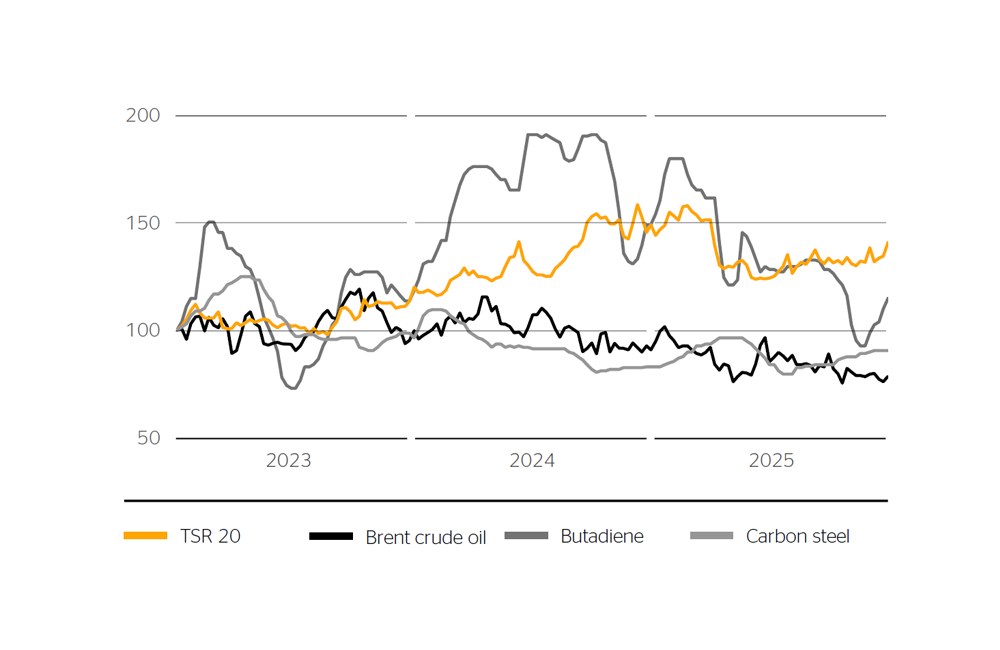
TSR 20, crude oil, butadiene and carbon steel
Indexed to January 1, 2023
Sources:
TSR 20: rolling one-month contracts from the Singapore Exchange (US $ cents per kg).
Crude oil: European Brent spot price from Bloomberg (US $ per barrel).
Butadiene: South Korea spot price (FOB) from PolymerUpdate.com (US $ per metric ton).
Carbon steel: hot-rolled coil Northern Europe ex works, from Kallanish Commodities (€ per metric ton).


