


Sustainability Report – Environmental Information
Resource Use and Circular Economy (ESRS E5)
Material Impacts, Risks and Opportunities Related to Resource Use and Circular Economy
Continental assessed its actual and potential negative and positive impacts as well as abstract and tangible risks and opportunities related to resource use and circular economy according to the regulatory requirements, as described in the General Disclosures (ESRS 2) section. The general disclosures include an overview of the assessment of all identified impacts, risks and opportunities (IROs), including the time horizons considered.
In this IRO assessment, the material impacts, risks and opportunities related to resource use and circular economy were identified. For easier understanding and reading, they have been grouped together into the following IRO clusters:
- Circularity
- Waste in own operations
The descriptions of potential negative impacts and abstract risks are presented from a business-inherent perspective. They outline general impact potentials and risk exposures based on structural aspects such as business activity, geographical aspects, business model and product characteristics. This does not take into account mitigation through the management approach of Continental described in the respective IRO cluster. Actual negative impacts, tangible risks, positive impacts and opportunities are described from a company-specific perspective and consider the outcomes of the management approaches. A detailed definition of the IRO types can be found in the Impact materiality and Financial materiality subsections in the General Disclosures (ESRS 2) section.
The descriptions of IROs are to be considered as self-contained, which may result in repetitions.
The following pages provide detailed descriptions of the IROs within respective IRO cluster. They also outline the management approach developed for each IRO cluster, which manages the identified impacts, risks and opportunities. In addition, the associated targets, actions and metrics are explained (where available).
Circularity
Material impacts, risks and opportunities in the circularity IRO cluster
ID |
Short description |
Type of IRO |
Primary |
Explanation |
||||
29 |
Sourcing from primary and non-renewable sources |
Potential and actual negative impact |
Short-term |
Continental sources a wide range of different materials and semi-finished products. Inherent to the respective industries and products, these also include various raw materials from primary or non-renewable sources (including fossil-based materials), such as synthetic rubber, carbon black, textiles, steel or additives, which could lead to potential negative impacts on the availability of these finite resources. Also when considering the management approach, this results in material actual impacts in relation to resource consumption. |
||||
30 |
Contribution to waste through end-of-life product treatment |
Potential and actual negative impact |
Short-term |
Continental produces a portfolio of products that, after use, are either disposed of or recovered. Despite the recycling systems that are already partially available worldwide, a significant share is still disposed of or utilized through energy recovery or downcycling due to industry- and process-inherent factors, which could lead to potential negative impacts on the environment. Also when considering the management approach, this results in material actual impacts related to end-of-life product treatment. |
||||
31 |
Higher costs for materials/ |
Abstract |
Medium-term |
Continental sources a wide range of different materials and semi-finished products through global supply chains. This results in an industry-inherent exposure to possible effects that may arise from significant changes in regulations and market requirements in relation to renewable and recycled materials. If market and regulatory requirements evolve faster than the supply chain can adapt, this could lead to market-driven cost increases for materials and semi-finished products. |
||||
32 |
Loss of sales in connection with our portfolio and |
Abstract |
Long-term |
Continental produces a portfolio of products whose design and end-of-life treatment are subject or could become subject to increasing regulatory and market requirements related to circularity. This results in a portfolio- and market-inherent exposure to possible effects that may arise from significant changes in regulations and market requirements. If these requirements tighten faster than adaptation measures for the portfolio and related business models can become effective, this could lead to sales losses. |
||||
33 |
Growth in connection with circular products |
Opportunity |
Long-term |
Continental produces a portfolio of products whose design and end-of-life treatment are subject or could become subject to increasing regulatory and market requirements related to circularity. This could create general potentials for additional sales growth and new business as well as competitive differentiation. Based on its portfolio orientation and existing management approaches, Continental assumes to be able to leverage these opportunities. |
||||
Management approach for circularity
Continental is convinced that mobility and the global economy must be cleaner and transition to a circular economy to protect ecosystems, supporting their resilience and regeneration. As part of our sustainability ambition, we are committed to reducing our impact on the environment by improving resource efficiency, implementing preventive measures and reducing pollution in our own operations, while fostering these practices along our value chain.
In addition to fulfilling this ambition, the management approach seeks to mitigate related circularity risks, taking into account the different requirements and transformation speeds of our customers, industries and markets. It is also designed to prevent negative environmental impacts related to resource inflows and outflows.
The management approach covers the upstream and downstream value chain as well as Continental’s own operations and includes switching from primary to secondary resources and materials.
The procurement of renewable and recycled (secondary) materials is a key element. Continental refers to the following definitions in reference to the Tire Industry Project:
- Renewable material: Bio-based material that returns to its previous stock levels by natural growth or replenishment processes at a rate in line with use cycles. Therefore, it is replenished or regrown at a rate equal to or faster than harvested or extracted.
- Recycled material: A material that has been reprocessed from a recovered or reclaimed discarded material by means of a manufacturing process and made into a final product or a component for incorporation into a product.
The management approach applies to the entire Continental Group and product portfolio and covers resource inflows and outflows.
The respective business functions bear responsibility for managing and adapting their respective product portfolio. Oversight of the effectiveness of portfolio management is exercised by the group sector decision bodies and Continental’s Executive Board. Key processes are handled by the respective departments within the company such as research and development (R&D), product design, supply chain management and purchasing. These are supported by the sustainability departments.
The management approach includes specific processes for resource inflows and outflows, considering technological, biological and product cycles. For resource inflows and outflows, the related key actions related to purchased resources are mainly managed within purchasing, product design, R&D and sustainability processes.
As part of the R&D-led material approval process, among other things, renewable and recycled materials intended to be introduced into production processes are identified. The material approval process typically involves laboratory evaluation, followed by testing and processing assessments before a material is approved.
When sourcing renewable and recycled materials, the purchasing departments request information on the share of renewable and recycled materials. Wherever possible, we request higher proportions of renewable and recycled materials from suppliers. In addition, traceability mechanisms such as the mass balance approach are also integrated into material procurement. Further information can be found in the description of the target related to circularity and the key actions for target achievement.
Continental also engages in strategic discussions with selected suppliers to intensify circularity efforts, for example through respective adjustments in product design and material composition.
With ContiLifeCycle, a system for reuse, respectively extending tire service life, we use recycled materials in our products. Thereby, hot and cold retreading of truck tires and the associated reclaim production of recycled rubber leads to significantly reduced waste generation and conserving natural resources. Within the retreading process, truck tire carcasses that are still intact get new treads so that the tires can be used again. This reduces the number of old tires in circulation, contributes to saving energy and raw materials and to lower the ecological footprint. Continental generally strives to avoid landfilling end-of-life tires as much as possible.
For resource outflows, the management approach includes actions with regard to product circularity, that is primarily managed through product design and R&D processes, focused on enhanced reusability, repairability, recyclability, durability and overall circularity. This includes own activities as well as industry collaborations and partnerships. Globally, depending on legal frameworks, there are various tire take-back processes that enable better utilization of end-of-life tires for circular processes. Further information can be found in the Key actions for target achievement related to circularity subsection.
In the ContiTech group sector, a newly developed pilot facility with exclusive patents at the Hanover-Vahrenwald plant enables to produce purified pyrolysis oil through thermal oxidation, laying the foundation for recycling complex rubber compounds on an industrial scale.
Continental’s sustainability ambition sets the overarching framework for the definition and implementation of actions.
Continental uses the mass balance approach to trace dedicated materials. This is a production-related control method in which certified and non-certified materials along the entire value chain are physically mixed but quantitatively tracked through verifiable bookkeeping. Based on internationally recognized principles, renewable and recovered raw materials can thus be integrated into existing production processes. Using the mass balance approach, Continental can document and track the exact amount of renewable and recovered materials used and check that quantity ratios match. The mass balance approach enables Continental to reduce complexity and efficiently manage raw material portfolios across multiple production sites in different markets, while tracking and allocating sustainable materials site-specifically. Additionally, Continental can thus accelerate the introduction of more sustainable materials, continuously increases their share in tires and facilitates the adoption of new technologies by suppliers. Continental certifies this process under ISCC PLUS, an internationally recognized certification scheme, and is consistently expanding its application across production sites.
The management approach and associated actions especially take into consideration customer requirements and investor inquiries. For resource inflows, direct suppliers as part of the upstream value chain are primarily and directly involved. For resource outflows, the perspectives of stakeholders relevant to end-of-life product treatment are also taken into account, for example through industry initiatives.
Continental communicates its approach to managing circularity externally through the publication of the annual report, trade fairs, press releases and investor dialogues, and internally via various channels such as sustainability and product conferences , working groups and the company-wide intranet. In addition, for specific products such as the UltraContact NXT car tire and the Conti Urban HA 5 NXT city bus tire, which currently combine the highest share of renewable and recycled materials in our portfolio, the percentage shares are explicitly disclosed and transparently communicated to the market.
Targets related to circularity
Continental has set a public sustainability target for circularity for the Tires group sector related to renewable and recycled materials. Continental has set itself the target to increase the share of purchased renewable and recycled production materials for its tires to at least 40% by 2030.
The target is linked to Continental’s management approaches for circularity described in this section, as well as for Scope 3 emissions, value chain resilience and transition in the Climate Change (ESRS E1) section of this sustainability report. The processes involved in the management approach for circularity for resource inflows are crucial for both topic areas, as a higher share of renewable and recycled materials leads to a reduced carbon footprint of materials while serving as a key building block for closed resource loops.
Continental has identified key levers for resource inflows to increase the share of purchased renewable and recycled production materials for tires. These comprise measures for selecting renewable and recycled materials, which are typically managed by R&D, and identifying new suppliers or developing existing ones to secure relevant amounts of renewable and recycled materials in procurement processes. These are set out in specific material roadmaps and are regularly updated. Corresponding certifications of origin or other instruments for proofing origin and traceability help to achieve the target as they can create transparency in supply chains.
Transitioning away from non-renewable resources is achieved by replacing non-renewable materials with alternatives from renewable sources. In addition, substituting primary materials with materials from secondary sources, such as from recycling processes, helps to achieve the target. A prerequisite for selecting renewable and recycled materials is the technical ability to integrate them into our tires without compromising safety or performance. This is ensured through the general material approval process, as described earlier under processes within the management approach for circularity.
Based on the materials identified and approved as renewable and recycled resource inflows, a joint strategy development process takes place between purchasing, R&D and sustainability. For materials that have been identified as being able to make a significant contribution to achieving the target, the purchasing departments develop and maintain dedicated material roadmaps. These roadmaps assess the general availability of each material in the required quantities and allow conclusive analysis of their market availability at economically viable costs. Purchasing sufficient quantities of these materials is managed through a balanced purchasing strategy that includes long-term contractual agreements as well as short-term purchasing activities for flexibility in dynamic markets.
The transparency and the proof of the use of renewable and recycled materials is a key lever for achieving the set target. As with many of our highly complex chemical value chains, material flows can hardly be physically be traced at the individual level. Continental therefore also applies the mass balance approach to purchases of materials, as described above in the management approach for circularity. The purchasing departments as well as the sustainability department of the Tires group sector primarily manage the related activities.
The scope of this sustainability target covers all purchased renewable and recycled production materials for tires in the Tires group sector’s own operations. Retreaded tires and non-production materials are not taken into account for achieving this target.
This intensity target is measured by the metric “Share of purchased renewable and recycled production materials for tires” in percentage and monitored by the Sustainability Steering Committee. The base year is 2024, and thus the baseline value corresponds to the prior-year result of the metric.
No interim targets have been set.
The generally accepted concept of circularity, according to scientific studies, primarily includes recycling and the use of renewable resources. Continental’s target setting follows this general approach but does not apply a specific methodology for science-based target setting.
To improve the accuracy of material inflows recorded as renewable or recycled, mass balance approaches, as described, have proven to be a practical option in complex value chains over recent years.
The methodology for calculating the metric is described in the corresponding metric explanations. The target value of at least 40% was defined based on internal feasibility studies and market extrapolations regarding the increase of the share of renewable and recycled materials. As the share of natural rubber, which essentially contributes to the metric, depends heavily on the tire portfolio mix due to its specific properties, portfolio aspects were also taken into account when setting the target.
The target takes into account the interests of different stakeholders, such as customers, through direct and indirect consultations.
The target has been reported since the sustainability report for the fiscal year 2024 and has not changed since then.
Continental’s targets focus on resource inflows, particularly on increasing the share of renewable and secondary materials and reducing the use of primary materials. Here, we follow the cascading principle to use raw materials or products made of them in their material form for as long, as often and as efficiently as possible.
The target specifically supports the recycling level of the waste hierarchy, as well as the level of prevention.
The target was set voluntarily to support the transition to closed resource and product cycles.
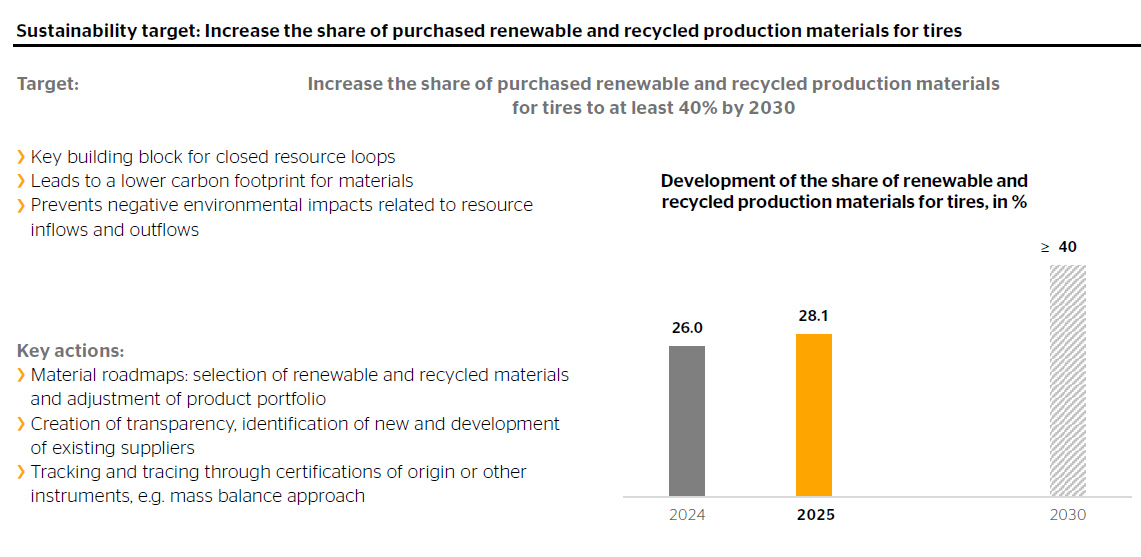
Metrics for target achievement related to circularity
Through the implementation of the key actions described, the share of purchased renewable and recycled production materials for tires increased by more than 2 percentage points. Accordingly, also the total weight of purchased renewable and recycled production materials for tires rose. This was, for example, contributed by the procurement of ISCC PLUS-certified synthetic rubber and resins, expanded supplier assessments and the identification of additional materials, while – due to changes in the composition of the product portfolio - a counteracting effect was recorded in relation to natural rubber.
The progress of related key actions for target achievement in the reporting year is primarily assessed based on progress toward the target KPIs. In 2025, this progress was within the expected range to achieve the target by 2030.
| Renewable and recycled production materials for tires | 2025 |
2024 |
| Total weight of purchased renewable and recycled production materials for tires, in million t | 0.6 | 0.5 |
| Share of purchased renewable and recycled production materials for tires, in % | 28.1 | 26.0 |
Total weight of purchased renewable and recycled production materials for tires
- The name of in the indicator in the previous year was “total weight of the renewable and recycled materials inflow (raw materials of the Tires group sector only)”. The wording has been aligned with the target formulation.
- The metric only includes the Tires group sector and relates to Continental’s public sustainability target for circularity.
- The total weight of recycled and renewable materials used to manufacture products corresponds to the purchased quantities of materials of the Tires group sector.
- The metric is entity-specific.
Share of purchased renewable and recycled production materials for tires
- The name of in the indicator in the previous year was “percentage of inflow of renewable and recycled materials (only raw materials of the Tires group sector)”. The wording has been aligned with the target formulation.
- The total weight of recycled and renewable materials used to manufacture products corresponds to the purchased quantities of materials.
- The absolute weight of renewable and recycled production materials in the Tires group sector is divided by the total weight of production materials used in the Tires group sector.
- The metric is entity-specific.
Key actions for target achievement related to circularity
Continental has introduced concrete actions to achieve the target of at least 40% renewable and recycled production materials for tires by 2030. These actions focus primarily on the following core levers:
- Material identification;
- Strategies for sufficient supply;
- Traceability, including through the mass balance approach.
Overall, the actions corresponding to the target are closely linked to the general management approach for circularity. To enable flexible reactions to changing market conditions and evolving needs, these actions are refined step by step.
Identifying renewable and recycled materials is a critical factor in achieving the target. Therefore, research and development (R&D) continuously evaluates alternative materials to replace non-renewable with renewable sources and primary with secondary sources. Innovative approaches are pursued, such as using plant-based materials instead of fossil-based fillers, oils and resins. Activities to increase the share of renewable and recycled materials are embedded in the operational processes of R&D. As a result, there is a comprehensive procedure for material identification, including material approval, which is identical for renewable and recycled, respectively non-renewable and non-recycled materials.
As the availability of certain materials is crucial, there is a defined set of renewable and recycled materials suitable for achieving the target. These materials are identified by internal experts from R&D, sustainability and purchasing. This serves as the basis for developing corresponding material roadmaps and purchasing strategies, which are continuously reviewed and updated. Raw materials and materials that contribute to increasing the share of renewable and recycled production materials in the initial steps especially include recovered raw materials from processes such as pyrolysis with recovered carbon black or oil and gas, as well as recycled materials like polyester and rubber.
With our ContiRe.Tex solution, developed together with the company Otiz, we have created a process for high-performance yarn that allows conventional polyester to be replaced with polyester made from recycled PET bottles. First products using recycled PET bottles are already on the market. The global rollout of this material across all Continental tire plants is planned and is already implemented at several plants.
Continental also works with ISCC PLUS-certified suppliers of circular resins based on renewable raw materials such as vegetable oil and used cooking oil. Continental is the first tire manufacturer to use the rubber additive TMQ made from biocircular acetone, which raw material is based on waste of biological origin such as recycled cooking oil.
The availability of recycled materials requires that products are returned to material cycles at the end of their life. To enable this,
Continental collects end-of-life tires through its global trade organizations and REG Reifen-Entsorgungsgesellschaft (tire disposal company for the DACH region) to make the resources usable again. With REG as a certified waste disposal company, Continental has been recovering tires since 1992, and thereby built up expertise within the company. Here, it is important to note that global take-back systems vary globally, such as extended producer responsibility, free-market systems and systems regulated by taxes and fees. Another element to recover end-of-life tires is through partnerships, such as with Pyrum Innovations.
Through the strategic partnership with Pyrum Innovations, we are using pyrolysis for implementing a circular concept for recycling end-of-life tires, and thus recovering recycled materials that can be reintegrated into our production processes.
Based on the identified materials that contribute to achieving the target of at least 40% renewable and recycled materials for tire production, material roadmaps are created. The creation and review of these roadmaps define the overall framework for long-term procurement measures with implementation scenarios. In addition, on this basis, specific short-term measures as flexible elements are developed, such as material-specific procurement activities, to respond to changing market conditions. These plans are aligned with the member of the Executive Board responsible for the Tires group sector, regularly reviewed and adjusted as needed. While the integration of selected materials requires only minor adjustments to production processes, their availability in large volumes at economically viable costs is a critical factor. In all cases, Continental maintains the same level of safety and performance for all tires sold. Wherever possible, Continental strives to secure large volumes of relevant materials on a long-term basis.
For the Tires group sector, natural rubber is a key raw material that also contributes to the share of renewable and recycled production materials. Through partnerships along the value chain and corresponding purchasing strategies, Continental will continue to source natural rubber and secure sufficient quantities for the coming years.
Creating transparency and obtaining reliable information on renewable and recycled materials across the various stages of its complex value chains is essential for Continental. Accordingly, the company uses mass balance approaches established as a standard in the chemical industry, as explained in the Management approach for circularity subsection. Continental sees mass balance approaches as a necessary tool for the transition away from fossil resources in our material value chains. In 2025, Continental achieved ISCC PLUS certification for all of its European tire plants and for its plants in Hefei, China, and Mount Vernon, USA. Certification of own plants does not directly contribute to achieving the target related to resource inflows, but it enables the declaration of mass-balanced materials in the end product.
Actions to increase the share of renewable and recycled materials in tire production are embedded in operational activities, especially in research and development and purchasing. The actions include short- and medium-term measures. For resource outflows, processes are primarily managed by the sustainability department of the Tires group sector and country-specific dealer organizations.
Capital expenditure and operating expenditure for key actions for target achievement related to circularity
Operating expenditure (OpEx) increased in the reporting year, primarily due to the classification of additional materials as renewable or recycled. The reported planned operating expenditure was adjusted accordingly. Capital expenditure (CapEx) related to key actions is currently negligible.
OpEx and CapEx of key actions for target achievement related to circularity, in € millions |
2025 |
2024 |
Planned 2026–2030 |
OpEx |
1,206 |
1,009 |
7,596 |
CapEx |
0 |
0 |
0 |
Definitions, assumptions and calculation methods:
OpEx and planned OpEx of key actions for target achievement
- Includes OpEx for key actions for target achievement related to circularity. Includes material costs for renewable and recycled materials in the Tires group sector.
- Data is collected at the level of materials. The calculation is based on an average data method using the purchased quantities of materials of the Tires group sector.
- The time horizon applied is in line with the approved long-term planning.
CapEx and planned CapEx of key actions for target achievement
- Includes CapEx for key actions for target achievement related to circularity. Includes project costs and intangible assets for technology conversion to production using renewable and recycled materials in the Tires group sector.
- Data is collected at the level of projects.
- The time horizon applied is in line with the approved long-term planning.
Further information related to circularity
Resource inflows
The total weight of products and materials used decreased significantly in the reporting year due to the structural effect of the spin-off of the former Automotive and Contract Manufacturing group sectors. As a result, the higher proportion of renewable or recycled materials in the Tires and ContiTech group sectors led to an increase in the relative share of these materials in the total weight. For secondary reused or recycled materials, the structural effect led to a slight decrease in absolute terms. In addition to this structural effect, the absolute values and the share of renewable and recycled materials inflow increased in the Tires group sector, as described in the subsection on key actions, as well as in the ContiTech group sector, offsetting the structural effect.
Resource inflows are described in the management approach for circularity in this section and in the Description of business model and value chain subsection in the General Disclosures (ESRS 2) section.
Metrics related to resource inflows |
2025 |
2024 |
Total weight of products (including packaging) and materials used, in million t |
3.0 |
3.7 |
Share of sustainably sourced biological materials and biofuels for non-energy purposes (including packaging), in % |
9.5 |
8.2 |
Total weight of reused or recycled secondary components, intermediate products and materials (including packaging) used to manufacture products and services, in million t |
0.2 |
0.2 |
Share of reused or recycled secondary components, intermediate products and materials (including packaging) used to manufacture products and services, in % |
5.8 |
5.3 |
Total weight of renewable and recycled materials inflow, in million t |
0.6 |
0.6 |
Share of renewable and recycled materials inflow, in % |
21.7 |
18.4 |
Definitions, assumptions and calculation methods:
Total weight of products (including packaging) and materials used
- Includes technical and biological materials. Services, property, plant and equipment, and trading goods are excluded.
- If no weight information is available, this is calculated using the costs of the materials and goods, such as packaging materials, with conversion factors.
Share of sustainably sourced biological materials and biofuels for non-energy purposes (including packaging)
- Biological materials are considered renewable materials according to generally recognized standards.
- Sustainably sourced refers to resource inflows that have been verified by external standards and certifications or other comparable schemes (such as PCAF, FSC, HPE, ISCC PLUS or material-specific supplier self-assessments). In particular, this includes our procurement of natural rubber via defined processes based on specific sustainability criteria such as the Global Platform for Sustainable Natural Rubber (GPSNR) and our sustainable natural rubber sourcing policy.
Total weight of reused or recycled secondary components, intermediate products and materials (including packaging) used to manufacture products and services
- The total weight of materials used to manufacture products corresponds to the purchased quantities of materials.
- Packaging from the upstream supply chain is excluded.
- The share of secondary materials is based both on information from suppliers and, in some cases, expert assessments for certain materials. Due to missing or inconsistent data on packaging in some cases, internal expert assessments of the weight of specific packaging types were used to extrapolate the total weight using a factor and corresponding expenditure.
Share of reused or recycled secondary components, intermediate products and materials (including packaging) used to manufacture products and services
- The metric is composed of the previously defined metrics.
Total weight of renewable and recycled materials inflow
- Non-production-related materials, including packaging, are excluded. The total weight of raw materials used to manufacture products corresponds to the purchased quantities of materials.
- The metric is entity-specific.
Share of renewable and recycled materials inflow
- The total weight of recycled and renewable raw materials used to manufacture products corresponds to the purchased quantities of materials.
- Non-production-related materials, including packaging, are excluded.
- The metric is entity-specific.
Resource outflows
Continental’s main resource outflows, including waste, in terms of their material impacts, risks and opportunities are described in the General Disclosures (ESRS 2) section and in this section under the Waste in own operations IRO cluster.
Products and materials
Continental’s product portfolio covers a broad spectrum, particularly in the areas of industry and vehicles. A detailed description can be found in the General Disclosures (ESRS 2) section. The implementation of our sustainability ambition related to circular economy is described in the management approach for circularity in this section.
Continental offers a broad product portfolio, especially for vehicles and industry. Due to differences in individual products, target markets, use cases and user behavior, it is almost impossible to predict expected durability across the board. The actual durability of a specific product may deviate from the following estimates.
For all tires, operating conditions vary significantly depending on vehicle and use as well as other factors such as air pressure, load, speed, road conditions, rotation frequency and storage conditions. Nevertheless, passenger-car tires and commercial-vehicle tires must be replaced when the tread depth falls below 1.6 mm, as this is the minimum legal limit in the European Union. In industry-wide product tests by external associations, passenger-car tires often achieve an overall mileage of 20,000 km to 70,000 km before reaching the legal minimum tread depth of 1.6 mm. Here, Continental tires consistently rank among the best. Additionally, the tire industry generally recommends inspecting a tire after 10 years and replacing it if necessary.
The industrial business of the ContiTech group sector covers a diverse portfolio with different applications and specifications across numerous industries, such as drive belts, storage solutions, hoses and niche products like printing blankets. Expected durability can vary significantly depending on surrounding conditions and the final application, which is not always known to Continental. These key factors influencing the product’s longevity result in lifespans ranging from a few years to several decades.
Currently, there is no established external assessment system for the repairability of Continental’s products. Nevertheless, we continuously work on expanding circular product design, as described in the management approach for circularity, and among other things offer corresponding services and products. In principle, our products can be repaired in case of damage, but actual feasibility depends on many factors, including the product’s actual condition and the extent of damage. In particular, damage such as punctures in tires can be repaired using specific methods to allow continued use. Continental also operates its own international network of automotive workshops, which, in addition to selling and replacing tires, also perform general vehicle repairs. Products from the ContiTech group sector can also be repaired under certain conditions. Also here, we offer respective services such as repairs for our conveyor belts or hose solutions.
For safety-relevant components such as tires, repairability may be restricted for safety reasons. The corresponding management approaches for technical (product-related) compliance and safe mobility can be found in the Consumers and End-Users (ESRS S4) section.
The share of recyclable components in product packaging remained unchanged at 100 percent. The share of recyclable content in products increased due to the spin-off of the former Automotive and Contract Manufacturing group sectors.
Share of recyclable components/content |
2025 |
2024 |
Share of recyclable components in product packaging, in % |
100 |
100 |
Share of recyclable content in products, in % |
67.5 |
61.3 |
Definitions, assumptions and calculation methods:
Share of recyclable components in product packaging
- The quantity of packaging purchased corresponds to the quantity of packaging used.
- The data is reported centrally.
Share of recyclable content in products
- Data is based on purchasing data and calculated on a group sector-specific basis.
- The metric defines the share of a product’s content by weight that can potentially be recycled. This value may differ significantly from the actual recycling of this content.
- If no weight information is available, this is calculated using the costs of the materials and goods, such as packaging materials, with conversion factors.
Waste in Own Operations
Material impacts, risks and opportunities in the waste in own operations IRO cluster
ID |
Short description |
Type of IRO |
Primary |
Explanation |
34 |
Landfill or incineration of non-recoverable waste in own operations |
Potential |
Short-term |
Continental operates a wide range of industrial processes that industry and process inherently generate waste, such as material scrap, offcuts or process residues. These can be partially difficult to recover or may contain hazardous substances. This results in a potential for negative impacts associated with the treatment and disposal of waste. |
35 |
Waste efficiency |
Opportunity |
Medium-term |
Continental operates a wide range of industrial processes that industry and process inherently generate waste, such as material scrap, offcuts or process residues. By reducing waste, there is process-inherent potential for material efficiency gains with regards to operating expenditure and expenditures for materials and semi-finished products. Based on its existing management approaches, Continental assumes to be able to leverage these opportunities. |
Management approach for waste in own operations
Continental is convinced that mobility and the global economy must be cleaner and transition to a circular economy to protect ecosystems, supporting their resilience and regeneration. As part of our sustainability ambition, we are committed to reducing our impact on the environment by improving resource efficiency, implementing preventive measures and reducing pollution in our own operations. Accordingly, Continental has developed a waste management approach integrated into its overall environmental management system to mitigate the negative impacts of landfilling or incinerating non-recoverable waste from own operations and to make optimal use of opportunities related to waste efficiency. More information on the management approach for general environmental management can be found under Environmental protection in own operations in the Emissions and Substances (ESRS E2) section. A waste hierarchy has been in place at Continental’s locations for many years, which prioritizes actions to reduce waste generation, followed by material reuse, recycling and energy recovery from waste. The least preferred option is disposal, such as landfilling. By following this hierarchy, we can reduce environmental impacts and promote sustainable resource use. Continental strives to gradually reduce waste at its own locations step by step and year by year. Due to the different business operations within the company, specific programs are tailored to the needs by each group sector.
The management approach for waste management covers the entire Continental Group.
Continental’s environmental strategy is steered and approved by the Executive Board. The associated programs are coordinated within internal committees of the environmental protection departments.
Waste management is embedded in Continental’s environmental management systems. Processes such as standardization, cataloging and digitalization for accurate tracking of waste streams can help prevent waste. Additionally, we also regularly share best practices among our plants. The management and disposal of hazardous waste is subject to applicable legal requirements at the local level. We also work with external partners to recover waste. To ensure transparency in recovery and assume responsibility for waste processing, we use a multi-stage process together with our partners, consisting of self-assessments, requirement catalogs and audits.
Waste-related processes are monitored and continuously improved as part of general environmental management reviews as well as specific waste management reviews. By these, we consequently work on reducing the amount of waste generated overall and per product, and thereby to increase resource efficiency.
Continental’s environmental management system was developed in reference to ISO 14001, an internationally recognized standard for environmental management systems from the International Organization for Standardization (ISO).
The management approach reflects the interests of various stakeholders by using the generally established waste hierarchy and by reference to ISO 14001. Direct interaction with stakeholders in relation to waste primarily occurs with the responsible authorities.
Continental communicates its management approach for waste management through various channels to facilitate comprehensive understanding and engagement across the company. This includes regular trainings of employees, local awareness campaigns and information on the intranet, which make the approach and specific internal rules accessible to all employees.
Metrics related to waste in own operations
For all metrics related to waste for recovery and waste for disposal, there was a significant reduction in the reporting year due to the spin-off of the former Automotive and Contract Manufacturing group sectors.
At the same time, methodological changes regarding the allocation of construction waste to recovery, respectively disposal apply at the level of the Tires and ContiTech group sectors. In the ContiTech group sector, the amount of waste for disposal also decreased in 2025.
Waste for recovery
Waste for recovery, in million t |
2025 |
2024 |
(1) Non-hazardous waste for reuse |
0.000 |
0.000 |
(2) Non-hazardous waste for recycling |
0.223 |
0.309 |
(3) Non-hazardous waste for other recovery operations |
0.055 |
0.069 |
(4) Non-hazardous waste for recovery |
0.277 |
0.378 |
(5) Hazardous waste for reuse |
0.000 |
0.000 |
(6) Hazardous waste for recycling |
0.006 |
0.017 |
(7) Hazardous waste for other recovery operations |
0.007 |
0.009 |
(8) Hazardous waste for recovery |
0.013 |
0.025 |
(9) Total waste for recovery |
0.291 |
0.403 |
Definitions, assumptions and calculation methods:
General information for items (1) to (9)
- The data is collected by the locations. For certain locations, modeled calculations are used considering the number of employees and the type of operation. In addition, waste generated in the month of December is estimated for some locations if the necessary data or proofs were not yet available at the time of reporting.
- Waste that contractually or legally belongs to an external third party is not taken into account.
- Hazardous waste is defined in accordance with Annex III of Directive 2008/98/EC of the European Parliament and of the Council on waste.
- Non-hazardous waste refers to waste that does not fall under the definition of hazardous waste. Construction waste is, for calculation purposes, fully allocated to landfill in the calculation of recovery.
(1) Non-hazardous waste for reuse
- Reuse refers to any operation in which products and components that are not waste are used again for the same purpose for which they were designed, without significant modification.
- Material for reuse does not end up in the waste register. Instead, it is immediately transferred to the corresponding material storage facility.
- Consequently, no waste is generated that is intended for reuse.
(2) Non-hazardous waste for recycling
- Recycling is defined as any recovery operation in which waste materials are reprocessed into products, materials or substances, whether for the original or another purpose.
(3) Non-hazardous waste for other recovery operations
- Other recovery operations include the generation or recovery of energy through incineration of waste that is to be used as fuel or other means to generate energy.
(4) Non-hazardous waste for recovery
- Total of items (1) to (3).
(5) Hazardous waste for reuse
- Reuse refers to any operation in which products and components that are not waste are used again for the same purpose for which they were designed, without significant modification.
- Material for reuse does not end up in the waste register. Instead, it is immediately transferred to the corresponding material storage facility. Consequently, no waste is generated that is intended for reuse.
(6) Hazardous waste for recycling
- Recycling is defined as any recovery operation in which waste materials are reprocessed into products, materials or substances, whether for the original or another purpose.
(7) Hazardous waste for other recovery operations
- Other recovery operations include the generation or recovery of energy through incineration of waste that is to be used as fuel or other means to generate energy.
(8) Hazardous waste for recovery
- Total of items (5) to (7).
(9) Total waste for recovery
- Total of items (4) and (8).
Waste for disposal
Waste for disposal, in million t |
2025 |
2024 |
(10) Non-hazardous waste for incineration |
0.000 |
0.001 |
(11) Non-hazardous waste for landfill |
0.042 |
0.041 |
(12) Non-hazardous waste for other disposal operations |
0.005 |
0.006 |
(13) Non-hazardous waste for disposal |
0.047 |
0.047 |
(14) Hazardous waste for incineration |
0.002 |
0.003 |
(15) Hazardous waste for landfill |
0.003 |
0.006 |
(16) Hazardous waste for other disposal operations |
0.004 |
0.005 |
(17) Hazardous waste for disposal |
0.009 |
0.014 |
(18) Total waste for disposal |
0.056 |
0.061 |
General information for items (10) to (18)
- The data is collected by the locations. For certain locations, modeled calculations are used considering the number of employees and the type of operation. In addition, waste generated in the month of December is estimated for some locations if the necessary data or proofs were not yet available at the time of reporting.
- Waste that contractually or legally belongs to an external third party is not taken into account.
- Hazardous waste is defined in accordance with Annex III of Directive 2008/98/EC of the European Parliament and of the Council on waste.
- Non-hazardous waste refers to waste that does not fall under the definition of hazardous waste.
- Construction waste is, for calculation purposes, fully allocated to landfill in the calculation of recovery.
(12) Non-hazardous waste for other disposal operations
- Other disposal operations are defined as disposal operations that do not fall under incineration or landfill. This includes, for example, the pre-treatment of predominantly liquid or paste-like special waste through various chemical, thermal and physical processes to achieve an output suitable for disposal.
(13) Non-hazardous waste for disposal
- Total of items (10) to (12).
(16) Hazardous waste for other disposal operations
- Other disposal operations are defined as disposal operations that do not fall under incineration or landfill. This includes, for example, the pre-treatment of predominantly liquid or paste-like special waste through various chemical, thermal and physical processes to achieve an output suitable for disposal.
(17) Hazardous waste for disposal
- Total of items (14) to (16).
(18) Total waste for disposal
- Total of items (13) and (17).
Other waste metrics
Relevant waste streams are described in this section in the management approach for waste in own operations.
The materials contained in Continental’s waste are largely determined by the specific resource inflows and are described in the management approaches in this section.
For the other absolute waste metrics, there was a significant decline in the reporting year, mainly due to the spin-off of the former Automotive and Contract Manufacturing group sectors. In addition, the total amount of waste generated also declined in both the Tires and ContiTech group sectors.
The spin-off also resulted in a higher share of non-recycled waste in 2025.
The waste for recovery quota remained constant in the reporting year. While the structural change had a negative effect on the quota, it increased in the ContiTech group sector and remained stable at a high level in the Tires group sector. Overall, these effects largely outbalanced one another.
Other waste metrics |
2025 |
2024 |
Total amount of waste generated, in million t |
0.347 |
0.464 |
Total amount of hazardous waste, in million t |
0.022 |
0.039 |
Total amount of radioactive waste, in million t |
0.000 |
0.000 |
Amount of non-recycled waste, in million t |
0.118 |
0.138 |
Share of non-recycled waste, in % |
34.1 |
29.9 |
Waste for recovery quota, in % |
87.2 |
87.2 |
Definitions, assumptions and calculation methods:
Total amount of waste generated
- The metric comprises the total waste of all locations worldwide. Sold or discarded machines, wastewater and waste that contractually or legally belongs to an external third party are not taken into account.
- The data is collected by the locations. For certain locations, modeled calculations are used considering the number of employees and the type of operation.
Total amount of hazardous waste
- Total of items (8) and (17) from the “Waste for recovery” and “Waste for disposal” tables.
- Waste that contractually or legally belongs to an external third party is not taken into account.
Total amount of radioactive waste
- Radioactive waste is defined in Article 3 (7) of Council Directive 2011/70/Euratom (Annex I).
- Continental does not generate any radioactive waste.
Amount and share of non-recycled waste
- Total of items (3), (7) and (18) from the “Waste for recovery” and “Waste for disposal” tables.
- Waste that contractually or legally belongs to an external third party is not taken into account.
- Share calculated as the amount of non-recycled waste divided by the amount of waste generated.
Waste for recovery quota
- The metric is the total of hazardous and non-hazardous waste for recovery and energy recovery divided by the total amount of waste.
- Contrary to the amount of waste generated, construction waste is not included.
- The data is collected by the locations. For certain locations, modeled calculations are used considering the number of employees and the type of operation.
- The metric is entity-specific.


