


Sustainability Report – Social Information
Own Workforce (ESRS S1)
Material Impacts, Risks and Opportunities Related to Own Workforce
Continental assessed its actual and potential negative and positive impacts as well as abstract and tangible risks and opportunities related to own workforce according to the regulatory requirements, as described in the General Disclosures (ESRS 2) section. The general disclosures include an overview of the assessment of all identified impacts, risks and opportunities (IROs), including the time horizons considered.
In this IRO assessment, the material impacts, risks and opportunities related to own workforce were identified. For easier understanding and reading, they have been grouped together into the following IRO clusters:
- Labor standards
- Occupational safety and health
- Employee privacy
- Responsible employer
Unlike in the previous year, the IRO cluster “labor standards” now also includes IROs related to adequate wages and work-life balance. IROs related to training and skills development, and secure employment and social dialogue have been combined into the new IRO cluster responsible employer.
The descriptions of potential negative impacts and abstract risks are presented from a business-inherent perspective. They outline general impact potentials and risk exposures based on structural aspects such as business activity, geographical aspects, business model and product characteristics. This does not take into account mitigation through the management approach of Continental described in the respective IRO cluster. Actual negative impacts, tangible risks, positive impacts and opportunities are described from a company-specific perspective and consider the outcomes of the management approaches. A detailed definition of the IRO types can be found in the Impact materiality and Financial materiality subsections in the General Disclosures (ESRS 2) section.
The descriptions of IROs are to be considered as self-contained, which may result in repetitions.
Further Information on the IRO Assessment in Relation to Own Workforce
In the IRO assessment, Continental identified both actual and potential positive and negative impacts on its own workforce in the topic areas of labor standards, occupational safety and health, employee privacy and responsible employer. These impacts are associated with Continental’s strategy and business model and relate in particular to countries, certain markets, industries and business activities that are critically or significantly exposed to such impacts.
The identified actual and potential impacts on own workforce are important for adapting the strategy and business model. The development of actions and strategic decisions based on the identified impacts are described as part of the management approaches.
As indicated by the respective descriptions, all identified risks result directly from identified actual and potential impacts as well as from the dependence on own workforce as an important intangible resource. They are also based on the breadth and diversity of countries, markets, industries and business activities in which Continental operates.
Therefore, the risks are inherently linked to Continental’s strategy and business model.
The consolidated assessment of impacts, risks and opportunities for own workforce includes Continental’s entire workforce. Links to business activities, the product portfolio and the value chain are taken into account where relevant.
In general, our activities have actual or potential positive or negative impacts on the entire workforce of Continental – both own employees and non-employees. Non-employees include temporary workers and subcontractors.
The IRO assessment led to a deeper understanding of which parts of the workforce are more exposed to certain risks based on particular activities, environments or characteristics. This understanding is especially based on the consideration of industry specifics, regional factors and potential discrimination characteristics as part of the IRO assessment, as described in the respective IROs.
Continental operates in many industries, countries and markets worldwide, including regions with significant potential for negative impacts related to child labor, particularly in China, Mexico and Brazil.
The same applies analogously to forced labor (including so-called debt bondage).
The assessment of material negative impacts on own workforce was integrated into the general impact, risk and opportunity assessment following the defined methodology (see the General Disclosures (ESRS 2) section, Overview of material impacts, risks and opportunities subsection).
The methodology considers two perspectives: Firstly, it considers potential negative impacts that are to be considered widespread or systemic, as they relate to countries, specific markets, industries, and business operations in which Continental operates. Secondly, the methodology considers event-based actual negative impacts when the description of the impacts includes a reference to specific actual incidents.
Reported positive impacts on the workforce are linked to activities described in the management approach for each IRO cluster.
The material impacts on own workforce are not directly related to sustainability-driven changes, such as the transition to zero-tailpipe-emission vehicles.
Material risks arising from impacts and dependencies on own workforce affect Continental’s entire workforce.
The following pages provide detailed descriptions of the IROs within the respective IRO cluster. They also outline the management approach developed for each IRO cluster, which manages the identified impacts, risks and opportunities. In addition, the associated targets, actions and metrics are explained (where available).
Labor Standards
Material impacts, risks and opportunities in the labor standards IRO cluster
ID |
Short description |
Type of IRO |
Primary |
Explanation |
||||
36 |
Negative impacts on |
Potential |
Short-term |
Continental employs people in different regions and markets worldwide. Across these regions, legal frameworks and market practices regarding labor and remuneration standards differ. This results in an inherent potential for negative impacts related to adequate wages and fair payment. |
||||
37 |
Negative impacts on freedom of association of own workforce |
Potential |
Short-term |
Continental employs people in different regions and markets worldwide. Across these regions, legal frameworks and market practices for safeguarding freedom of association differ. This results in an inherent potential for negative impacts on exercising freedom of association and thus indirectly on related labor rights and protection mechanisms. |
||||
38 |
Negative impacts on employees’ working time |
Potential |
Short-term |
Continental employs people in different regions and markets worldwide. Across these regions, legal frameworks and market practices regarding working time differ. This results in an inherent potential for negative impacts related to working time, which could adversely affect employees’ health and well-being. |
||||
39 |
Negative impacts on |
Potential |
Short-term |
As an industrial manufacturing company, shift models are employed at Continental, including night shifts and rotating schedules. This results in an industry process-inherent potential for negative impacts on employees’ work-life balance. |
||||
40 |
Negative impacts in connection with discrimination in own operations |
Potential |
Short-term |
Continental employs people in different regions and markets worldwide. Across these regions, legal frameworks, market practices and general societal norms regarding anti-discrimination differ. This results in an inherent potential for negative impacts on employees due to discrimination, for example based on gender, age, ethnic origin, religion or other characteristics. |
||||
41 |
Negative impacts in connection with incidents of forced labor in own operations |
Potential |
Short-term |
Continental employs people in different regions and markets worldwide. This also includes certain regions and markets where legal frameworks and market practices for preventing forced labor (including so-called debt bondage) are limited. This results in a region-inherent potential for negative impacts. |
||||
42 |
Negative impacts in connection with incidents of child labor in own operations |
Potential |
Short-term |
Continental employs people in different regions and markets worldwide. This also includes certain regions and markets where legal frameworks and market practices for preventing child labor are limited. This results in a region-inherent potential for negative impacts. |
||||
43 |
Sanctions in connection with incidents related to working conditions in own operations |
Abstract and tangible risk |
Medium-term |
Continental employs people in different regions and markets worldwide. Across these regions, legal frameworks and market practices regarding working conditions differ and sometimes include transnational components. This results in an inherent exposure to possible effects that may arise from existing regulations, significant tightening or new requirements. In the event of severe incidents related to working conditions, this could lead to fines and penalties, remediation costs or a temporary interruption of the respective business operation under current or tightened regulations. In the unlikely event of a severe incident, a tangible risk would already arise under current regulations. |
||||
44 |
Higher operating costs in connection with working conditions in own operations |
Abstract |
Medium-term |
Continental employs people in different regions and markets worldwide. Across these regions, legal frameworks and market practices regarding working conditions differ and sometimes include transnational components. This results in an inherent exposure to possible effects that may arise from existing regulations, significant tightening or new requirements. If requirements are tightened significantly, such as across multiple regions simultaneously and affecting fundamental work organization, this could lead to higher operating costs. |
||||
45 |
Sanctions in connection with discrimination in own operations |
Abstract and tangible risk |
Medium-term |
Continental employs people in different regions and markets worldwide. Across these regions, legal frameworks, market practices and general societal norms regarding anti-discrimination differ. This results in an inherent exposure to possible effects that may arise from existing regulations, significant tightening or new requirements. In the event of severe incidents related to discrimination, this could lead to fines and penalties, remediation costs or a temporary interruption of the respective business operation under current or tightened regulations. In the unlikely event of a severe incident, a tangible risk would already arise under current regulations. |
||||
46 |
Sanctions in connection with human rights in own operations |
Abstract and tangible risk |
Medium-term |
Continental employs people in different regions and markets worldwide. This also includes certain regions where legal frameworks and market practices for protecting human rights (e.g. preventing forced or child labor) are limited. This results in an inherent exposure to possible effects that may arise from existing regulations, significant tightening or new requirements. In the event of severe incidents related to human rights, this could lead to fines and penalties, remediation costs or a temporary interruption of the respective business operation under current or tightened regulations as well as contractual requirements. In the unlikely event of a severe incident, a tangible risk would already arise under current regulations. |
||||
47 |
Loss of sales/boycott in connection with incidents related to human rights in own operations |
Abstract |
Medium-term |
Continental employs people in different regions and markets worldwide. This also includes certain regions where legal frameworks and market practices for protecting human rights (e.g. preventing forced or child labor) are limited. This results in an inherent exposure to possible effects that may arise from existing regulations, significant tightening or new requirements. In the event of severe incidents related to human rights, this could lead to sales losses due to customer boycotts or suspended business relationships, particularly in product segments directly associated with the Continental brand. |
||||
Management approach for labor standards
Continental has defined a management approach for labor standards for its own workforce that is intended to prevent and reduce actual and potential negative impacts and risks with regard to working time, anti-discrimination, forced labor and child labor, other human rights and working conditions, freedom of association, work-life balance as well as adequate wages. The approach is integrated into Continental’s general HR processes (e.g. workforce planning, recruiting, employee development and HR administration) and the responsible value chain due diligence system (RVCDDS).
Continental is convinced that global value chains must be built on business ethics and respect for human rights. We support the principles and objectives of the United Nations (UN) Guiding Principles on Business and Human Rights and are committed in our sustainability ambition to responsible business practices and business ethics as well as safe, healthy, fair and inspiring working conditions in our own operations. As part of the RVCDDS, Continental has adopted responsible value chain commitments (RVC commitments), which for labor standards include: no child labor, fair payment, equal treatment, no forced labor or modern slavery, freedom of association and adequate working conditions, including working time.
Continental strives to create a work culture that is free from any form of discrimination, including harassment. This is an integral part of the management system and is supported by a dedicated diversity management aimed at promoting equal opportunities, diversity and inclusion.
The RVC commitment explicitly addresses creating a work environment free from discrimination based on gender, age, ethnicity, color, health status, disability, social origin, nationality, sexual orientation, political opinion, religion or belief, or any other characteristic protected by applicable laws and regulations.
The topic of inclusion and actions for people from disadvantaged employment groups are also part of this RVC commitment.
The management approach also covers the prevention of potential trafficking in human beings, forced or compulsory labor and child labor. Continental firmly rejects child labor and does not employ anyone under the age of 15, under the age at which compulsory schooling ends or under the minimum employment age in the respective country, whichever is higher. Young workers under the age of 18 must be treated with special care. Forced labor, modern slavery, debt bondage, human trafficking or any other form of involuntary work are also firmly rejected. Employees must be provided with documented employment terms or an offer of employment in a language they can understand. Migrant workers must be treated with special care.
With its management approach for adequate wages, Continental aims for fair payment for all employees. Remuneration paid to employees complies with applicable laws and regulations, including those relating to minimum wages, living wages, overtime and statutory benefits.
The management approach covers Continental’s own employees, while the RVC commitments also include non-employees.
Overall responsibility for the management approach and the RVCDDS, including the RVC commitments for labor standards, lies with the Executive Board. The latter has appointed a human rights officer to oversee the RVCDDS. Specific rules for labor standards are defined and implemented by the respective HR departments in line with the company structure. Responsibility for implementing labor standards lies with the management of the respective entities.
The system comprises many processes, such as strategy development and implementation, the management of regulations, impact and risk management, case management (including whistleblowing) and training. A multi-level process based on the Three Lines Model has been set up to monitor the effectiveness of the system. The first line is formed by local operational HR departments. They implement operational tasks at business level and at the locations in accordance with the RVCDDS and related rules on labor standards. The second line, represented mainly by non-operational HR departments and roles, as well as the human rights officer, oversees the system, roles and responsibilities as well as their appropriateness and effectiveness. The third line is Group Internal Audit, which carries out internal audits of the RVCDDS.
Specific preventive and remedial measures are defined for each RVC commitment related to labor standards, implemented by the entities. These measures include, for example, self-assessments, implementation of appropriate rules and instructions, careful analysis of the work environment for factors that could cause harm, implementation of improvement measures and control mechanisms, and raising awareness, particularly among managers.
With regard to working time, Continental has implemented further dedicated processes for flexible work models, as detailed in the following management approach for the responsible employer IRO cluster.
Continental’s general remuneration processes include the involvement of employee representatives and the consideration of benchmarks. These measures provide a foundation for preventing inadequate wages. In addition, specific rules define tangible preventive and remedial measures for entities. These include regularly checking whether payments comply with national and local legislation, clearly communicating remuneration principles to employees, ensuring timely and regular payments, and reviewing and updating appropriate benchmarks. The effectiveness of the management approach is measured using the metric for adequate wages.
As part of an annual review process with the Executive Board, the entire RVCDDS, including the specific processes for labor standards in own operations, is evaluated in terms of effectiveness, adequacy and potential for improvement. The RVCDDS is additionally integrated into the overarching internal control system, the risk management system and the compliance management system of Continental.
In line with the RVC commitments, the RVCDDS also defines the framework for implementing remedial measures in own operations. Any identified violation must be addressed immediately, and remedial measures must be implemented without undue delay. These measures are designed not only to resolve the violation but also to ensure that similar violations are prevented in the future.
Specific processes to prevent discrimination and address incidents are part of HR processes, the RVCDDS and the general processes of the whistleblower system described in the Business Conduct (ESRS G1) section. Anti-discrimination measures are implemented through general HR processes, particularly by improving general conditions. Additional initiatives target women and other employee groups, including awareness programs, educational offerings and transparent HR processes for recruitment and talent management. Continental also supports the creation of internal networks to promote equal opportunities and diversity and prevent discrimination. Meanwhile, several such networks exist at Continental’s locations worldwide, organized and managed by employees.
With regard to gender diversity, Continental has defined a target and key actions for target achievement, as described in the targets related to own workforce and key actions for target achievement subsections in this section.
The RVCDDS is regulated by a dedicated group rule for a responsible value chain. This complements existing general and specific HR rules, which define details on labor standards, including anti-discrimination and remuneration topics. Additionally, respect for human rights and fair working conditions are embedded in Continental’s Code of Conduct, which forms the basis for collaboration among all employees.
Continental’s management approach for labor standards is aligned with both local regulations – such as local laws on wages – and international frameworks. These include internationally recognized conventions on human rights, such as the UN Guiding Principles on Business and Human Rights and the standards of the Responsible Business Alliance (RBA).
Continental’s management approach to respect for human rights and labor standards is also in line with the core principles of the UN International Bill of Human Rights, the International Labour Organization (ILO) Declaration on Fundamental Principles and Rights at Work, and the Organisation for Economic Co-operation and Development (OECD) Guidelines for Multinational Enterprises. These commitments serve as a global minimum standard for all Continental locations and form the basis for compliance with local laws and regulations. Additionally, Continental is a signatory of initiatives such as the German Charta der Vielfalt (Diversity Charter). The company also endorses the Women’s Empowerment Principles established by the UN Global Compact and UN Women, demonstrating its dedication to promoting diversity and inclusion across its operations. Monitoring compliance with these standards is indirectly anchored in the RVCDDS review process, including updates to rules and processes as needed.
To incorporate stakeholder interests into the management system, Continental has established various formats. These include specific workshops and conferences, which are defined as measures by the labor standards rules. Remuneration models are discussed with the involvement of the respective works councils or employee representatives in order to consider employees’ interests. Specific cases of discrimination, inadequate wages or any other violation of labor standards can also be reported via the integrity system.
The consideration of this information is integrated into the overarching annual RVCDDS review process. Another platform for incorporating stakeholder interests is the regular employee survey OUR BASICS Live, in which Continental’s employees are asked about different topics related to Continental’s values, including labor standards.
To ensure a comprehensive understanding and engagement related to labor standards within the organization, Continental communicates the management approach through diverse channels. In particular, these include mandatory training for managers on the RVCDDS and the RVC commitments, our website and internal communication platforms, where training materials and group rules are made available. In addition, posters and in-person training sessions provide access to relevant information for employees without IT infrastructure. Integration into the onboarding process helps familiarize new employees with the standards from the start.
Additionally, all actors involved in implementing the management approach have clearly defined roles within general HR processes and the RVCDDS and are trained on their responsibilities to enable effective collaboration and implementation of the management approach.
Targets related to labor standards
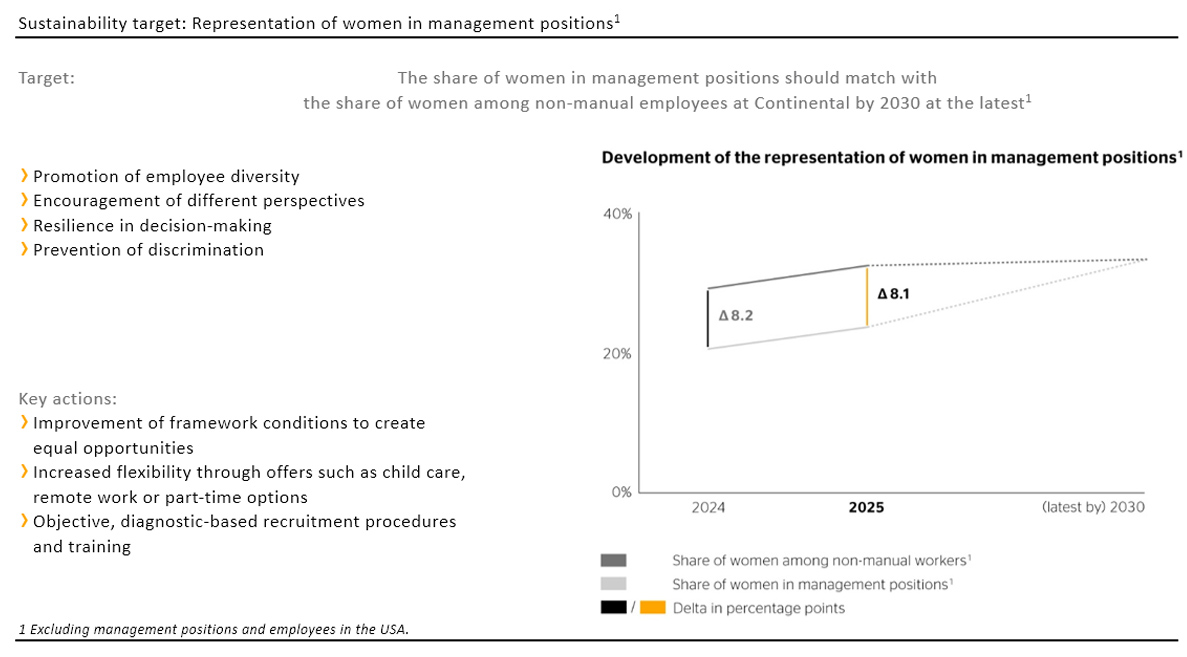
With regard to labor standards for its own workforce, Continental has set a time-bound target in the area of anti-discrimination, diversity and equal opportunities regardless of gender. Continental relies on a work environment that is as free as possible from any form of discrimination and that promotes the strengths of its diverse workforce. Diversity includes, for us for example, internationality and gender of employees, different experiences and age generations, as well as many other factors that characterize our workforce. A diverse workforce and management team bring different perspectives to the organization and thus enhances resilience in decision-making. Representation of diversity, particularly at the management level, also plays an important role in preventing discrimination within the organization. Representatively for the various dimensions of anti-discrimination, diversity and equal opportunities regardless of gender, we have set the following public sustainability target: the share of women in management positions should match with the share of women among the non-manual employees at Continental by 2030 at the latest, excluding management positions and employees in the USA.
The target was revised during the reporting period and now focuses on women to be represented in management positions according to their share among non-manual employees. This also allows changes resulting from shifts in the structure of the workforce to be reflected in the target. The previous target was based on achieving a fixed value of the share.
The scope of the target includes all management positions (senior executives and executives) and, as a reference point, all non-manual workers worldwide, excluding management positions and employees in the USA.
With the adoption of the target during the reporting year, this reporting year also serves as the initial year for future reporting on progress.
No interim targets have been set.
The target addresses the company’s overall management culture and especially the impacts and risks related to equal treatment and anti-discrimination, as described in the management approach for labor standards in this section. Additionally, it provides an indication of internal permeability of the organization. Indirectly, it also addresses topics such as adequate wages and skills development.
Progress toward the target is measured using the metric “delta between the share of women in management positions and the share of women among non-manual workers”, excluding management positions and employees in the USA.
This metric is monitored continuously and reported at least once a year.
The target itself is based on the general principle of representation. The share of women among non-manual workers was selected as the reference point because the development path into management positions emerges from this group. The metric women in management positions (excl. USA) which is underlying the calculation of the difference was previously reported as “gender diversity – share of female senior executives and executives excluding the USA” - and is calculated based on a defined methodology, excluding management positions and employees in the USA, and has been reported for several years.
Employee representations are actively involved in the target achievement process and related key actions through the respective HR processes.
The involvement of affected stakeholders and identification of shared experiences and improvement potential, such as through networks, are presented in the key actions for target achievement.
Metrics for target achievement related to labor standards
The metric for target achievement was reported for the first time in the reporting year. Compared with the previous year, also reported for the first time, there was an improvement in the delta between the share of women in management positions (excluding the USA) and the share of women among non-manual workers (excluding the USA), from 8.2 to 8.1 percentage points. The underlying effects largely offset one another. Structurally, the spin-off of the former Automotive and Contract Manufacturing group sectors led to an increase in the share of women in management positions (excluding the USA) as well as simultaneously an increase in the share of women among non-manual workers (excluding the USA). At the same time, in the Tires and ContiTech group sectors, the share of women in management positions (excluding the USA) increased, supported by the key actions described. In parallel, the share of women among non-manual workers (excluding the USA) rose in both group sectors.
Metrics for target achievement related to labor standards |
2025 |
2024 |
Share of women among non-manual workers (excl. USA), in % |
31.7 |
28.8 |
Share of women in management positions (excl. USA), in % |
23.6 |
20.6 |
Delta between the share of women in management positions and the share of women among non-manual workers (excl. USA), in %-points |
8.1 |
8.2 |
|
|
|
Definitions, assumptions and calculation methods:
General information
- Includes employees of the Continental Group with a valid, active and permanent employment contract as of December 31 of the respective reporting year. Trainees and non-employees are not included.
- Gender distribution is based on the information provided by employees in Continental’s systems. The metric takes into account the female gender and the male gender.
- Senior executives and executives are defined by Continental’s grading system.
- Relevant entities are included in the metric. Entities in the USA are excluded.
- The data is collected by the entities of the Continental Group.
- The metrics are entity-specific.
Share of women among non-manual workers
- The metric is calculated by dividing the number of female non-manual workers by the total number of non-manual workers as of December 31 of the reporting year.
Share of women in management positions
- The metric is calculated by dividing the number of female senior executives and executives by the total number of senior executives and executives as of December 31 of the reporting year.
Delta between the share of women in management positions and the share of women among non-manual workers
- Continental’s public sustainability target for the representation of women in management positions is calculated as the delta between the share of women in management positions and the share of women among non-manual workers as of December 31 of the respective reporting year.
Key actions for target achievement related to labor standards
The key actions to implement the labor standards target on the representation of women in management positions extending beyond the general management approach include a range of initiatives and programs. Given the nature of the target, romoting anti-discrimination, diversity and equal opportunities is also an important management task.
Continental took market analyses into account when defining appropriate actions. Consideration was also given to various aspects of improving representation, preventing discrimination and meeting the requirements of different markets.
The defined levers that have been implemented to achieve the “representation of women in management positions” target focus on improving structural conditions to help promote equal opportunities for all employees. The aim is to strengthen overall internal permeability within the organization. These include increasing flexibility through offers such as childcare, remote work or part-time options, as well as the use of objective, diagnostic-based recruitment and training procedures. To create a culture of inclusion and belonging and prevent discrimination, Continental promotes awareness and education on these topics through leadership philosophy and development as well as guidelines on diversity and anti-discrimination.
In addition to numerous initiatives aimed at all managers and employees, Continental has launched specific initiatives for women to promote their professional development and, as a result, strengthen their representation in management positions. They include events, talent management and development offerings as well as networks.
These measures are not only aimed at the achievement of the target but also support prevention of discrimination and equal treatment of employees in general.
Given the anti-discrimination nature of the key actions, it is assumed that they will reduce related negative impacts from possible discrimination incidents, thereby also reducing the potential risks for the company.
No material positive impacts related to anti-discrimination and diversity were identified in the IRO assessment.
No material opportunities were identified either.
Key resources for the action plan include expenditure for improving structural conditions and specific initiatives for women.
The actions related to the target support the management approach for labor standards by helping to reduce potential negative impacts on own workforce, also in the event of conflicting economic and social interests.
The specific initiatives for women are geared to the entire female workforce, also beyond management positions. The actions relating to structural conditions are deliberately much broader and ultimately address the diversity of the entire workforce.
The actions include short-, medium- and long-term measures.
The key actions for target achievement are not directly related to a specific remedial process. Where relevant, remedial actions are based on general processes for dealing with incidents, as described for the integrity system.
The effectiveness of the actions in terms of impact and risk is assessed indirectly by tracking the progress made toward achieving the targets within the management levels considered and through general evaluations of anti-discrimination efforts.
Capital expenditure and operating expenditure for key actions for target achievement related to labor standards
Operating expenditure (OpEx) related to the improvement of structural conditions and specific initiatives for women was significantly lower at group level in the reporting year compared with the previous year. The main reasons were the spin-off of the former Automotive and Contract Manufacturing group sectors and a reduction in central activities of holding functions as part of the restructuring processes.
Operating expenditure in the Tires group sector increased in 2025 due to the relocation of holding activities. By contrast, it decreased in the ContiTech group sector as a result of restructuring measures.
Since the key actions are primarily associated with operating expenditure, only very low levels of capital expenditure (CapEx) were incurred in the reporting year, as in the previous year.
The planned values for future OpEx and future CapEx were adjusted accordingly during the reporting year.OpEx and CapEx of key actions for target achievement related to labor standards, in € millions |
2025 |
2024 |
Planned 2026–2030 |
OpEx |
7 |
13 |
32 |
CapEx |
0 |
0 |
2 |
Definitions, assumptions and calculation methods:
General information
- Includes OpEx and CapEx related to the improvement of structural conditions and specific initiatives for women.
- The data is collected by the entities of the Continental Group.
- Values for 2024 are reported according to the former targets for the Continental Group and the 2024 organizational structure.
Planned OpEx and planned CapEx
- The time horizon applied is in line with the approved long-term planning.
- Planned values are extrapolated at group level based on the OpEx and CapEx incurred during the reporting year that relate to the improvement of structural conditions and specific initiatives for women. Approved projects based on existing long-term planning are also included.
Further metrics related to labor standards
Metrics related to the distribution of own employees by gender and age
Due to the spin-off of the former Automotive and Contract Manufacturing group sectors, the following metrics for gender distribution and employee distribution by age group within the Continental Group included in 2025, for the first time, only the employees of the Tires and ContiTech group sectors and the restructured holding company. This resulted in the total number of own employees, as well as the number of senior executives and executives, being reduced by roughly half compared with the previous year.
At the level of the Tires and ContiTech group sectors, the number of senior executives and executives increased during the reporting year due to the restructuring of the holding company, while it decreased accordingly within the holding company.
Viewed by age group, the changes to the Continental Group’s structure led to a lower share of employees under 30 and a higher share of employees over 50.
At the level of the Tires and ContiTech group sectors, the shares of the age groups changed only marginally compared with the previous year.
Metrics related to the distribution of own employees by gender and age |
2025 |
2024 |
Gender distribution – senior executives and executives (as of December 31), number of employees (headcount) |
|
|
Male |
1,062 |
2,330 |
Female |
319 |
602 |
|
|
|
Own employees by age group (as of December 31), number of employees (headcount) |
|
|
under 30 years old |
14,069 |
33,983 |
30–50 years old |
54,001 |
112,334 |
over 50 years old |
22,024 |
37,042 |
Total number of own employees |
90,094 |
183,358 |
|
|
|
Own employees by age group (as of December 31), in % |
|
|
under 30 years old |
16 |
19 |
30–50 years old |
60 |
61 |
over 50 years old |
24 |
20 |
Total, in % |
100 |
100 |
Definitions, assumptions and calculation methods:
General information
- Includes own employees of the Continental Group with a valid and active employment contract as of December 31 of the respective reporting year. Interns, trainees and non-employees are not included.
- The data is collected by the entities of the Continental Group.
Gender distribution – senior executives and executives
- Gender distribution is based on the information provided by employees in Continental’s systems. The metric takes into account the female gender and the male gender.
- Senior executives and executives are defined by Continental’s grading system.
Own employees by age group
- Age distribution is based on the information provided by employees in Continental’s systems.
Metrics related to safeguarding human rights in own workforce
At group level, the number of reported cases, incidents and complaints relating to other social or human rights matters decreased significantly in the reporting year due to the spin-off of the former Automotive and Contract Manufacturing group sectors.
At the level of the Tires group sector, the total number of cases, incidents and false reports of discrimination, including harassment, increased in the reporting year. However, this increase was largely offset by a decrease in the ContiTech group sector and within the holding company, resulting in a lower overall number of cases for the reporting year.
In addition to the structural effect caused by the change in the scope of consolidation, the total number of complaints related to social or human rights matters (excluding discrimination) also decreased in the reporting year due to fewer complaints in the Tires and ContiTech group sectors as well as in the holding company.
There were no fines, penalties or compensation in connection with human rights incidents in the reporting year.
No severe human rights violations related to own workforce became known during the reporting year.
Accordingly, no fines, penalties or compensation in connection with severe human rights violations related to own workforce were paid.
Metrics related to safeguarding human rights in own workforce |
2025 |
2024 |
Total number of cases, incidents and false reports of discrimination, including harassment |
157 |
294 |
Total number of complaints related to social or human rights matters, excluding discrimination |
56 |
139 |
Total amount of fines, penalties and compensation in connection with human rights incidents, |
0 |
0 |
|
|
|
Total number of known incidents of severe human rights violations related to own workforce |
0 |
0 |
Total amount of fines, penalties and compensation in connection with severe human rights violations, |
0 |
0 |
Definitions, assumptions and calculation methods:
General information
- The data is collected through the various complaint mechanisms of the Continental Group.
Total number of cases, incidents and false reports of discrimination, including harassment
- Discrimination, including harassment, is a violation of the RVC commitment “equal treatment”.
- Incidents are confirmed cases.
- Entity-based reporting is used to count cases, incidents and false reports of discrimination (including harassment) that involve a person belonging to Continental’s own workforce and that were reported in Continental’s systems during the reporting year.
Total number of complaints related to social or human rights matters, excluding discrimination
- Includes complaints related to social or human rights matters (excluding discrimination) that involve a person belonging to Continental’s own workforce and that were reported in Continental’s systems during the reporting year.
- Duplicates are included in the result.
Total amount of fines, penalties and compensation in connection with human rights incidents
- Includes confirmed incidents related to human rights that were reported in Continental’s systems and that involve a person belonging to Continental’s own workforce.
- Only as relevant classified incidents are included. The severity of incidents is assessed regularly as part of case management in the RVCDDS.
- Fines, penalties and compensation paid during the reporting year are included.
- Related expenses within the meaning of the ESRS would be reported in the Consolidated Statement of Income of the Consolidated Financial Statements under “Other expenses”.
Total number of known incidents of severe human rights violations related to own workforce
- The severity of incidents is assessed regularly as part of case management in the RVCDDS.
- Includes confirmed severe incidents of human rights violations that were reported in Continental’s systems during the reporting year and that involve a person belonging to Continental’s own workforce.
Total amount of fines, penalties and compensation in connection with severe human rights breaches
- Fines, penalties and compensation paid during the reporting year are included.
- Related expenses within the meaning of the ESRS are reported in the Consolidated Statement of Income of the Consolidated Financial Statements under “Other expenses”.
Metrics related to adequate wages
Continental is committed to equal treatment of employees. This corporate value drives our remuneration strategy, which forms the basis for the remuneration of all employees.
In line with our RVC commitment “fair payment,” Continental paid all employees an adequate wage in the reporting year, in accordance with applicable national laws or relevant minimum wage requirements and benchmarks.
In 2025, the gender pay gap included for the first time only the Tires and ContiTech group sectors as well as the restructured holding company. It amounted to 2.9%. Because the gender pay gap is reported on an unadjusted basis, the structural changes, such as shifts in the distribution of employees across high-wage and low-wage countries, resulted in a significantly lower gender pay gap. The gender pay gap within the Tires and ContiTech group sectors remained largely stable.
The remuneration ratio of the total remuneration of the Chief Executive Officer to the median of the total workforce was 122 in 2025 (PY: 139). Here, too, the change was mainly due to structural effects.
Metrics related to adequate wages |
2025 |
2024 |
Own employees paid below an adequate wage, in % |
0 |
0 |
Gender pay gap, in % |
2.9 |
22.9 |
Remuneration ratio of the CEO to the median of the total workforce |
122 |
139 |
Definitions, assumptions and calculation methods:
General information
- Includes own employees of the Continental Group with a valid and active employment contract as of December 31 of the respective reporting year. Interns, trainees and non-employees are not included.
- The data is collected by the entities of the Continental Group.
Own employees paid below an adequate wage
- Wage data is defined as base salary.
- An adequate wage is defined as a wage that satisfies the needs of the employee and their family, considering the given national economic and social conditions.
- Adequate wages are in accordance with the applicable national laws. If not available, national or sub-national minimum wages as established by legislation or collective bargaining are considered. If not available either, benchmarks meeting relevance criteria are considered.
- For parts of the Continental Group that do not report data directly, the assessment of the risk of inadequate wages is based on the RVCDDS risk assessment for the RVC commitment “fair payment”.
Gender pay gap
- Gender distribution is based on the information provided by employees in Continental’s systems. This metric considers the female gender and the male gender.
- Salary or remuneration is defined as base salary, cash allowances, benefits in kind (e.g. non-cash benefits, company cars) and changes in pension values.
- The change in pension values corresponds to the average values per employee for the respective entity.
- For parts of the Continental Group that do not report data directly, an extrapolation of the primary data is applied.
Remuneration ratio of the CEO to the median of the total workforce
- The highest-paid individual corresponds to the CEO.
- Pay data or remuneration is defined as base salary, cash allowances, benefits in kind, company cars and changes in pension values.
- The change in pension values corresponds to the average values per employee for the respective entity.
- For parts of the Continental Group that do not report data directly, a calculation method is applied based on the country average calculated using primary data. If the data is not available, valid external statistics are used.
- The metric is calculated as the ratio of the CEO’s total annual remuneration to the median total annual remuneration of the company’s own employees excluding the CEO’s remuneration.
Occupational Safety and Health
Material impacts, risks and opportunities in the occupational safety and health IRO cluster
ID |
Short description |
Type of IRO |
Primary |
Explanation |
||||
48 |
Negative impacts on the health of own workforce |
Potential |
Short-term |
Continental operates a wide range of processes that are, among others, connected with physically intensive activities, handling of chemicals, working with heavy machinery, shift-based work models and other demanding activities. This results in a process-inherent potential for negative impacts on the health and safety of employees related to accidents, physical or mental stress. |
||||
Management approach for occupational safety and health
Continental is convinced that global mobility and industries need to be safe for people and is committed to safe and healthy working conditions in its own operations. That is why we have established a comprehensive management system for occupational safety and health in order to mitigate impacts on employees related to health hazards such as the use of machinery, handling of substances of concern, ergonomics and psychological stress. The system aims to implement preventive measures and eliminate hazards to avoid accidents and provide for the safety and health of all employees.
The management approach covers Continental’s own employees directly and non-employees indirectly.
Responsibility for the operational management of occupational safety and health lies with the management of the respective entities, as legally required in most countries. Individual accountability also plays a crucial role, as every supervisor and employee has a personal responsibility to uphold safety and health practices in their respective function. The framework for occupational safety and health is defined by the safety and health organization, which also supports its implementation. Responsibility for implementing safety and health matters is delegated to the location managers, who are supported by dedicated safety and health managers. Responsibility for specific safety and health matters is regulated individually. Oversight of the overall management approach rests with the Executive Board.
Occupational safety and health matters are managed through Continental’s occupational safety and health management system, which comprises processes and programs for complying with corresponding requirements for all locations.
Key elements of this system include specific processes governing organization, implementation, reporting and training on relevant safety and health topics such as occupational safety, health management, occupational medicine, ergonomics in the workplace and handling of substances of concern (see also the management approach for substances of concern and very high concern in the Emissions and Substances (ESRS E2) section).
The processes include establishing a clear structure for allocating resources and defining roles and responsibilities within the organization, risk and impact management to identify and mitigate potential hazards, consistent and transparent communication as well as employee training and skills development on relevant topics. Preventive measures are implemented on a site-specific basis as part of the overall processes.
Reporting processes have been introduced to monitor the system, and internal audits are carried out regularly. To support this monitoring, Continental has implemented targeted programs such as a group sector internal safety and health audit program to monitor compliance with internal standards and identify opportunities for improvement, for example in relation to the accident rate. Furthermore, external ISO 45001 certifications validate the appropriateness and effectiveness of the management system at many locations. Continental also monitors how effective the management system is using various metrics (see the Metrics related to occupational safety and health table in this section).
The occupational safety and health management system also includes the dedicated management of incidents in the workplace.
Specific processes, responsibilities and monitoring measures are defined in the rules governing occupational safety and health. Location-specific occupational safety and health management systems further specify requirements based on local needs.
In developing and implementing the management approach, Continental considers a wide range of external standards and commitments to comply with legal requirements and internationally recognized practices. Besides ISO 45001 as the international standard for occupational safety and health management systems, these include frameworks and standards such as the Luxembourg Declaration on Workplace Health Promotion in the European Union, the International Labour Organization (ILO) Declaration on Fundamental Principles and Rights at Work and other relevant human rights frameworks, as outlined in the management approach for labor standards.
Continental considers its employees’ interests in line with internal and external requirements. Employees and their representatives are involved in relevant processes to incorporate their perspectives, for example through special committees or consultations with works councils.
To maintain transparency across all levels of the company, the management approach is communicated via Continental’s internal communication platforms. These channels are also actively used to share information with employees on topics such as ergonomics and mental health and to provide them with personal tools. Another important pillar is training on occupational safety and health, which also includes mandatory courses for employees and supervisors. These are either conducted on-site or can be accessed through Continental’s learning platform, as presented in the management approach for responsible employer in this section. For additional on-site communication, safety and health managers identify and assess local requirements and advise location managers.
Metrics related to occupational safety and health
In the reporting year, Continental’s occupational safety and health management system continued to cover all of Continental’s own employees.
Certification of Continental plants for implemented occupational safety and health management systems (ISO 45001 or similar) was also continued. The share of employees covered by such certifications reached 60% at the end of the year (PY: 67%). The decline was mainly due to the spin-off of the former Automotive and Contract Manufacturing group sectors.
The sickness rate among Continental’s own employees was 4.1% in 2025 (PY: 3.3%). The increase was structurally driven by the spin-off of the former Automotive and Contract Manufacturing group sectors. At the level of the Tires and ContiTech group sectors, changes compared with the previous year were marginal.
The number of reportable work-related accidents amounted to 1,654 in the reporting year (PY: 1,974), corresponding to a rate of 10.1 (PY: 5.8) accidents per 1 million working hours. The accident rate of work-related accidents with lost workdays was 3.1 (PY: 2.1) per 1 million working hours. The changes compared with the previous year were primarily attributable to the spin-off of the former Automotive and Contract Manufacturing group sectors. In the Tires group sector, the accident rate of work-related accidents with lost workdays improved noticeably in the reporting year. Otherwise, accident-related metrics in the Tires and ContiTech group sectors remained roughly in line with the previous year.
In the reporting year, there were three fatalities as a result of work-related injuries and work-related ill health: two among own employees of Continental and one among other workers on Continental sites.
Metrics related to occupational safety and health |
2025 |
2024 |
Occupational safety and health management system, |
100 |
100 |
Occupational safety and health management system certifications (ISO 45001 or similar), |
60 |
67 |
|
|
|
Sickness rate, in % |
4.1 |
3.3 |
|
|
|
Number of reportable work-related accidents |
1,654 |
1,974 |
Rate of all reportable work-related accidents (number of work-related accidents per 1 million working hours) |
10.1 |
5.8 |
Accident rate of work-related accidents with lost workdays (number of accidents per 1 million working hours) |
3.1 |
2.1 |
|
|
|
Fatalities as a result of work-related injuries and work-related ill health |
|
|
Continental’s own employees |
2 |
0 |
Other workers on Continental sites |
1 |
1 |
Definitions, assumptions and calculation methods:
General information
- Includes own employees of the Continental Group with a valid and active employment contract as of December 31 of the respective reporting year. Interns, trainees and non-employees are not included.
- The data is collected by the locations of the entities of the Continental Group.
Occupational safety and health management system, employee coverage
- Group rules are mandatory for all of Continental’s own employees.
Occupational safety and health management system certifications (ISO 45001 or similar), employee coverage
- Only includes valid certifications and completed recertifications as of December 31 of the respective reporting year.
- The metric is calculated from the ratio of own workforce working at a certified location to the total number of Continental’s own workforce. A small number of employees who could not be assigned are considered not to be covered.
- The metric is entity-specific.
Sickness rate
- Sickness includes paid and unpaid sick days.
- This metric is calculated by dividing the total paid and unpaid sick days by the total number of contractual working hours.
- The metric is entity-specific.
Reportable work-related accidents
- The definition of work-related accidents is based on the ESRS. Work-related accidents (workplace accidents) are accidents that occur during working hours, are work-related and result in an injury leading to death, sick day(s), limited capacity to work or transfer to another job, medical treatment beyond first aid, loss of consciousness or significant diagnosed injuries. Way-to-work accidents are considered if Continental is responsible for the transportation.
- Locations determine reportable work-related accidents according to the above definition.
- To calculate the rate of all reportable work-related accidents, the number of reportable work-related accidents is multiplied by one million and then divided by the total number of working hours.
Accident rate of work-related accidents with lost workdays (number of accidents per 1 million working hours)
- Work-related accidents are accidents that occur during working hours and are work-related. The accident must result in one or more days lost after the day of the accident to be counted.
- Working hours are defined as paid working time.
- The number of work-related accidents is multiplied by one million and then divided by the total number of working hours.
- The metric is entity-specific.
Fatalities as a result of work-related injuries and work-related ill health
- Includes fatalities as a result of work-related injuries and work-related ill health.
- Includes own employees of the Continental Group with a valid and active employment contract in the reporting year.
- Other workers on Continental sites are defined as persons who work at Continental’s locations and who do not belong to Continental’s own workforce.
Employee Privacy
Material impacts, risks and opportunities in the employee privacy IRO cluster
ID |
Short description |
Type of IRO |
Primary |
Explanation |
||||
49 |
Infringement of |
Potential |
Short-term |
In the business operations of Continental, a wide range of sensitive employee data is processed, particularly in the context of HR processes. This results in a process-inherent potential for negative impacts in the event of improper handling or other data leaks. |
||||
Management approach for employee privacy
Continental has established a group-wide management approach for employee privacy that addresses compliance with data protection regulations, minimizes the risk of data breaches, protects personal data and promotes awareness of data protection within the company. Continental thereby aims to ensure that personal data is processed worldwide in accordance with the following general data protection principles: lawfulness, fairness, transparency, purpose limitation, data minimization, accuracy and time-limited storage.
The management approach covers Continental’s own employees as well as personal data of potential or former employees, customers, suppliers, other business partners, interested parties and other affected parties.
Responsibility for protecting employees’ data lies with the management of Continental’s respective entities and with all functions that process personal data. The appointed corporate data protection officer and their team are responsible for defining and implementing the data protection management framework. The corporate data protection officer and regional data compliance coordinators also support entities with implementation. Overall oversight is exercised by the Executive Board.
The processes for managing and monitoring the management approach within the comprehensive data protection program include secure collection, processing, storage and disposal of data.
To ensure data protection throughout these steps, Continental has implemented technical and organizational measures such as encryption of sensitive data and access controls to prevent unauthorized access. Continental also adheres to the principle of data minimization, meaning only data necessary for specific purposes is collected and processed. Regular privacy impact assessments are used to identify critical areas for action and initiate appropriate measures based on the results. Another key process within the data protection program is regular data protection training for employees.
To monitor the effectiveness of the program, data protection topics are included in both a regular audit questionnaire and the risk assessment questionnaire. Assessment results are reported by the corporate data protection officer to the respective management and the Executive Board.
With its management approach, Continental complies with binding data protection requirements in all countries where it operates, such as the European Union (EU) General Data Protection Regulation.
Data protection is also an integral part of the Code of Conduct for employees and is thus firmly anchored in the foundation of collaboration at Continental. In addition, a dedicated group rule formalizes the processes related to employee privacy. This rule also includes clearly defined binding corporate rules approved by the responsible German data protection authority. They guarantee a level of data protection across Continental worldwide that complies with the EU General Data Protection Regulation.
By definition, the most important stakeholders with regard to employee privacy are Continental’s employees. Their interests are defined in the relevant data protection laws. Concerns or complaints can be submitted via the channels provided for this purpose. The corporate data protection officer and regional data compliance coordinators ensure that these concerns are addressed and integrated into the management approach.
Continental informs employees about data protection measures and processes through internal communication channels. The compliance organization manages dedicated formats, including topic-specific information pages and regular training sessions, to keep employees informed and engaged. Additionally, stakeholders involved in implementing the management approach receive specialized training and information through structured meeting formats and relevant group rules.
Responsible Employer
Material impacts, risks and opportunities in the responsible employer IRO cluster
ID |
Short description |
Type of IRO |
Primary |
Explanation |
||||
50 |
Positive impacts on |
Actual and potential positive impact |
Short-term |
Continental employs people in different regions and markets worldwide. Across these regions, legal frameworks and market practices regarding working time differ. Continental promotes working conditions and models that, in some regions, go beyond legal frameworks and market practices. In these markets, this can lead to an improvement in employees' individual situation and conditions, as well as in general market practices. With regard to the employees’ individual situation and conditions, feedback from employees confirms an actual positive impact. |
||||
51 |
Negative impacts on |
Potential |
Short-term |
Continental operates in industries and markets undergoing transformations, for example in relation to digitalization, automation, geopolitical developments and competitive conditions. This results in an industry- and market-inherent potential for negative impacts on the secure employment of the workforce, for instance due to plant closures or restructuring. |
||||
52 |
Positive impacts on secure employment |
Potential |
Short-term |
Continental operates in industries and markets undergoing transformations, for example in relation to digitalization, automation, geopolitical developments and competitive conditions. Based on its established management approach, Continental assumes that a high level of secure employment can be achieved for employees – particularly with regard to further training and job placement – even in markets undergoing intensive transformation. |
||||
53 |
Positive impacts on social dialogue |
Potential |
Short-term |
Continental employs people in different regions and markets worldwide. Across these regions, legal frameworks and market practices regarding social dialogue with employees differ. Based on its established management approach, Continental assumes that employees worldwide can express their interests and needs through social dialogue and that these can respectively be considered in decision-making processes. |
||||
54 |
Positive impacts on |
Potential |
Short-term |
Continental’s processes involve a diverse range of tasks and job profiles, many of which require continuous training. Based on its established management approach, Continental assumes that this can have positive impacts on employees’ individual training and skill development, even beyond their current roles. |
||||
55 |
Business interruptions in connection with a lack of skilled workers |
Abstract and tangible risk |
Medium-term |
Continental operates in industries and markets undergoing transformations, for example in relation to digitalization, automation, geopolitical developments and competitive conditions. These could lead to acute or increasing competition for skilled workers. These developments result in an industry- and market-inherent exposure to the risk of not being able to recruit, retain or train sufficiently qualified employees. If Continental is unable to recruit, retain or train sufficiently qualified employees at individual locations, this could lead to production interruptions or reduced capacity in the respective business operations. A corresponding tangible risk for Continental already arises in some markets due to the intense competition for skilled workers. |
||||
Management approach for responsible employer
Continental is committed to fair and inspiring working conditions. To make our workplaces attractive, the management approach for responsible employer aims to promote the flexibility and well-being of all employees, regardless of their working time model, and to create favorable conditions to support work-life balance.
We also encourage continuous learning to help employees meet evolving skills requirements and thereby mitigate risks associated with skill gaps and business interruptions. At the same time, this has positive impacts on secure employment.
Finally, we aim to shape the transformation processes in our industries and markets in close dialogue with our employees, aligning economic and social needs.
The management approach for responsible employer is closely linked to the management approaches for labor standards and occupational safety and health, which focus primarily on compliance with applicable laws and regulations to protect employees from discrimination and health hazards in the workplace.
The management approach covers all of Continental’s own employees.
In principle, employment matters and social dialogue are regulated by labor law. Therefore, formal responsibility for the management approach is partly determined by local legislation. This includes the responsibilities of the Supervisory Board, the Executive Board, the management of Continental’s entities and co-determination bodies such as works councils. Operational implementation is primarily managed by Continental’s HR departments and managers across the company structure. Responsibility for training on specific topics, such as occupational safety, lies with the relevant specialist functions.
With regard to working time and flexible working conditions, Continental has implemented a wide range of actions to enable its employees to achieve a healthy work-life balance. These include hybrid work, flexible arrangements and working time models, sabbaticals, family-related leave (including parental leave) and flexible early retirement. Additional benefits offered by Continental include childcare options and sports programs. Continental is actively expanding flexible work opportunities and involving production employees in the process. For shift work models, Continental has implemented dedicated processes in accordance with local laws to enable greater flexibility. Implementation of these actions varies by location and is oriented along local needs and regulations.
Continental has created a comprehensive learning environment for further training and skills development. Specialized training content is developed by the various functions and units to meet specific needs and regulatory requirements. In addition to these function- and business-specific programs, there are company-wide training initiatives managed by the HR departments and implemented locally, such as leadership development programs. To deliver these programs, Continental has set up a dedicated learning platform. The platform categorizes available courses and training by topic, making them easily accessible to employees. It also manages the assignment of training programs to employees and enables tracking of course completion. In addition, aligning appropriate training and development measures is an integral part of appraisal discussions between supervisors and employees in order to support individual skills development through a standardized process.
With regard to secure employment, Continental has established a set of processes, projects and measures. These help mitigate the negative impacts of the transformation on employees and simultaneously create positive impacts in terms of job creation and skills development.
- Contract design focuses on offering employees long-term opportunities. Flexible working time, mobile work options and other benefits are intended to proactively reduce employee turnover.
- With regard to the impacts of the transformation of its industries and markets, Continental provides employees with a variety of opportunities for training and skills development, as described, to prepare them for the future labor market.
- Job changes are also supported through a global internal job market.
Social dialogue and employee engagement are managed through various processes. Formalized processes include employee representation through works councils or similar structures, as well as the regular employee survey OUR BASICS Live. In addition, Continental has established a variety of formats for social dialogue and employee engagement, including town hall meetings, networks, open calls and online platforms. This foundation for social dialogue is also the basis for managing employee matters in the transformation of our industries.
The effectiveness of the management approach is monitored via dedicated feedback channels, HR processes and the reported metrics “workplace representation”, “employee turnover” and “OUR BASICS Live Sustainable Engagement index”.
The processes within the management approach are governed by internal frameworks and supplemented by country-specific rules in compliance with local laws and agreements with works councils. Additionally, the company has created a comprehensive set of guidelines, tools, methods and training initiatives.
Key aspects of the management approach, particularly those related to secure employment and social dialogue, are regulated by local laws, ordinances and regulatory requirements. In addition, the management approach is based on research findings, best practices and industry standards such as ISO 29993, which serves as a reference for manager training programs.
To consider employee interests, Continental follows a collaborative approach by working closely with works councils and actively involving managers, employees and relevant functions such as the law department. To gain additional insights, Continental uses internal communication channels and integrates feedback processes into various dialogue formats and training courses.
Another formalized process is the OUR BASICS Live employee survey, which gathers employee opinions and views on topics related to Continental’s values. They are collected, consolidated and analyzed through an established process. Furthermore, co-determination practices such as employee representation on the Supervisory Board and the involvement of the Group Works Council in relevant decision-making processes directly incorporate the interests of employees and enable the alignment of management strategies with their needs.
Many communication and dialogue formats, such as town hall meetings, inherently foster social dialogue. Continental’s management approach is also communicated to employees through established internal channels, usually in the broader context of related transformations. This includes newsletters and dedicated channels managed by local works councils to inform the workforce. The aforementioned comprehensive learning platform is also available for information on training. This is complemented by local communication on-site to reach employees without access to the IT infrastructure.
Metrics related to responsible employer
In the reporting year, the OUR BASICS Live Sustainable Engagement index metric improved to 80% (PY: 79%). The main reason for this increase is that the consolidated results presented in the sustainability report exclude the former Automotive and Contract Manufacturing group sectors. For the respective group sector configurations at the time of the survey, the metric showed a slight improvement for Tires and a slight decline for ContiTech (see also the information on page 209).
At group level, the number of employees who left the company decreased to 11,804 in the reporting year due to the spin-off of the former Automotive and Contract Manufacturing group sectors (PY: 24,978). Employee turnover remained unchanged at 13% in 2025 (PY: 13%). At group sector level, both metrics decreased year-on-year in Tires and increased year-on-year in ContiTech as a result of restructuring measures.
Metrics related to responsible employer |
2025 |
2024 |
OUR BASICS Live Sustainable Engagement index, in % |
80 |
79 |
|
|
|
Number of employees who left the company |
11,804 |
24,978 |
Employee turnover, in % |
13 |
13 |
Definitions, assumptions and calculation methods:
OUR BASICS Live Sustainable Engagement index
- OUR BASICS Live Sustainable Engagement index is defined as the agreement of own employees with questions relating to the topic of sustainable engagement in the OUR BASICS Live employee survey.
- The survey is based on a representative random sample across all Continental locations worldwide.
- At the time of the survey in June 2025, the Automotive and Contract Manufacturing group sectors were still part of the Continental Group. The indicator result including these group sectors was 79% for the reporting year.
- The metric is entity-specific.
Number of employees who left the company and employee turnover
- Includes own employees of the Continental Group with a valid and active employment contract as of December 31 of the respective reporting year. Interns, trainees and non-employees are not included.
- The data is collected by the entities of the Continental Group.
- Termination of the employment relationship is defined as voluntary resignation by the employee, termination of the contract by Continental, retirement, fatal accident at work, termination agreement between Continental and the employee, or the end of a temporary contract.
- For retirement and fatal accidents at work, the metric contains a small amount of extrapolated data for parts of the Continental Group that did not report data directly.
- Employee turnover is defined as the number of employees who left the company in relation to the average number of employees.
Workplace representation (for EEA countries with a significant number of employees) |
||
Coverage rate |
2025 |
2024 |
0–19% |
|
|
20–39% |
|
|
40–59% |
|
|
60–79% |
|
|
80–100% |
Germany |
Germany and Romania |
Definitions, assumptions and calculation methods:
- Includes own employees of the Continental Group with a valid and active employment contract as of December 31 of the respective reporting year. Interns, trainees and non-employees are not included.
- Countries in the European Economic Area (EEA) with a significant number of employees are countries in which Continental employs >10 % of the total number of its own employees.
- The data is collected by the entities of the Continental Group.
- Continental has signed an agreement with the European Works Council (EWC) supporting employee representation and social dialogue at the European level.
Processes for Engaging with Own Workers and Workers’ Representatives About Impacts
Continental uses various channels to engage with employees in its own workforce. This engagement is part of the continuous development of the management approaches described. The general process for incorporating the perspectives of its own workforce into the strategy is described in the Consideration of stakeholder interests and perspectives subsection in the General Disclosures (ESRS 2) section of this sustainability report.
Continental maintains comprehensive internal communication, which includes networks for exchange as well as newsletters, webcasts and town hall meetings to keep employees informed. An important format for engaging with the workforce and gaining insights into their interests is the OUR BASICS Live employee survey, which collects feedback on different topics related to Continental’s values. These overarching channels are complemented by local communication.
Additionally, Continental is in constant dialogue with employee representatives. In Germany, employee representatives are part of Continental AG’s Supervisory Board. Employees are also represented by local works councils or similar bodies in order to take their interests into account in strategic decisions and processes wherever possible.
Engagement with employees therefore takes place both directly and indirectly through employee representatives.
The described network channels are continuously open for engagement, while formats such as webcasts are conducted on an ad-hoc basis. The OUR BASICS Live employee survey is conducted annually.
To engage with marginalized groups in its own workforce, Continental has established dedicated networks. These include diversity networks, as described in the key actions for target achievement related to gender diversity.
The channels are managed company-wide by Continental’s HR and communication departments. The Executive Board member for Group Human Relations (director of labor relations) holds overall responsibility and is informed by the departments on employee matters.
An important tool for measuring the effectiveness of engagement is the OUR BASICS Live employee survey. It captures feedback on communication and employee involvement and forms the basis for the metric OUR BASICS Live Sustainable Engagement index. The communication channels also include direct feedback options. Furthermore, the “workplace representation” metric serves as an indicator of social dialogue coverage.
Processes to Remediate Negative Impacts and Channels for Own Workforce to Raise Concerns
Grievance channels for own workforce
Continental has established dedicated mechanisms to enable its own workforce to raise concerns.
These are part of a comprehensive integrity system that comprises three channels: an integrity platform, an integrity hotline and an integrity e-mail address, as described in more detail in the Business Conduct (ESRS G1) section of this sustainability report. Employees as well as third parties outside the Continental Group can report violations of legal regulations, core values and ethical standards via these channels. The platform and hotline are managed by an external service provider. The integrity e-mail inbox is managed directly by a Continental case management team.
The channels are explicitly open for all employee matters.
The integrity channels can be accessed via our website, internal communication channels or an international phone hotline. They are available worldwide in multiple languages and accessible 24/7 to overcome barriers such as time zones and language differences.
Continental uses various channels and formats to raise awareness of the integrity system, including intranet articles, compliance newsletters and podcasts, mandatory training sessions and local on-site communication measures. Continental does not explicitly assess the awareness and trust of the own workforce in these channels.
To protect users of the integrity system, information about potential violations can be reported anonymously. Reporting and investigation information is treated confidentially in accordance with applicable laws throughout the entire management of the case. The whistleblowing process is in line with the German Whistleblower Protection Act and relevant international legislation.
The integrity system is formalized in a dedicated group rule that defines roles and responsibilities across all steps of reporting, case review and validation, investigation and sanctioning in an end-to-end process. Case management is subject to internal audits. In addition, Continental’s publicly available rules of procedure provide transparency on the handling of cases. Continental’s employees are also required to complete mandatory training on the topic of whistleblowing.
Remedial actions
When complaints are received through whistleblowing channels or audit findings, Continental follows a structured process to investigate and resolve each case. Remedial actions must be implemented promptly and in accordance with Continental’s frameworks. Based on these frameworks, the respective entities must implement measures to effectively resolve the violation and prevent similar incidents in the future. Remedial actions related to submitted cases are tracked using compliance case management software. Further information, including effectiveness monitoring, can be found in the Business Conduct (ESRS G1) section in the management approach for business conduct, corporate governance and corporate culture and in the Prevention and detection of corruption and bribery subsection, which describes the integrity system in detail.
Further Metrics Related to Own Workforce
In the Economic Report within the Management Report, the number of employees is disclosed in the Earnings, Financial and Net Assets Position section in the Earnings Position subsection under “Employees”. It should be noted that the metrics differ in terms of their definition.
All figures relating to Continental’s own employees reported in the following tables decreased at group level in the reporting year due to the spin-off of the former Automotive and Contract Manufacturing group sectors. At the level of the Tires group sector, employee-related figures changed only slightly compared with the previous year, whereas in the ContiTech group sector they declined as a result of adjustments to production volumes.
Continental uses fixed-term employment contracts to balance short-term fluctuations in demand while maintaining stable core workforces over the long term. This approach to managing personnel capacity was continued in the reporting year. The share of employees with fixed-term contracts relative to the total number of own employees in 2025 was slightly below the prior-year level.
Further metrics related to own workforce (headcount) |
2025 |
2024 |
Total number of own employees (as of December 31) |
90,094 |
183,358 |
Average number of own employees |
92,027 |
188,802 |
|
|
|
Own employees by gender (as of December 31) |
|
|
Male |
72,052 |
134,313 |
Female |
18,027 |
49,029 |
Other |
15 |
16 |
|
|
|
Employees with permanent contracts (as of December 31) |
83,434 |
168,761 |
Male |
66,802 |
123,965 |
Female |
16,617 |
44,780 |
Other |
15 |
16 |
|
|
|
Employees with temporary contracts (as of December 31) |
6,660 |
14,597 |
Male |
5,250 |
10,348 |
Female |
1,410 |
4,249 |
Other |
0 |
0 |
|
|
|
Employees without guaranteed working hours (as of December 31) |
0 |
0 |
Male |
0 |
0 |
Female |
0 |
0 |
Other |
0 |
0 |
Definitions, assumptions and calculation methods:
General information
- Includes own employees of the Continental Group with a valid and active employment contract as of December 31 of the respective reporting year or, for the calculation of the average, in the reporting year. Interns, trainees and non-employees are not included.
- The data is collected by the entities of the Continental Group.
Average number of own employees
- The average is the total headcount at the end of each month divided by 12.
Own employees by gender
- Gender distribution is based on the information provided by employees in Continental’s systems. This information therefore represents Continental’s state of knowledge, taking into account local legislation and co-determination. The gender “other” includes employees who identify as non-binary or have not provided any information.
|
||||
2025 |
Female |
Male |
Other |
Total |
Germany |
3,614 |
15,526 |
0 |
19,140 |
USA |
2,376 |
8,389 |
14 |
10,779 |
|
|
|
|
|
Germany |
8,180 |
30,730 |
0 |
38,910 |
Mexico |
8,193 |
11,711 |
0 |
19,904 |
Romania |
6,413 |
12,074 |
0 |
18,487 |
Definitions, assumptions and calculation methods:
- Includes own employees of the Continental Group with a valid and active employment contract as of December 31 of the respective reporting year. Interns, trainees and non-employees are not included.
- The data is collected by the entities of the Continental Group.


